American Presidents All had a Sibling

Yesterday I told you about two Presidents who weren’t Fathers—other than being Founding Fathers.

GeorgeWashingtonDid you know that no American President has been an only child in his family?

Bill Clinton had his own half-brother. Of course you’ve heard about him.

President Gerald Ford came from a family and had two half-sisters, and four half-brothers.

And the longest serving President, Franklin D. Roosevelt also had a half-brother, a younger sibling.

George Washington also had a half-brother, Lawrence. , and a half-brother Augustine, Jr. Augustine, George’s father, then re-married and with Mary Ball had six children, of which George was the oldest. read more
Happy Father’s Day!

GeorgeWashingtonI want to wish all you Fathers a Happy Father’s Day, 2016! Being a father myself, I know how good it makes you feel to be acknowledged as a good father.

But did you know that two of our nation’s Founding Fathers, were indeed Founding Fathers, but they had NO children of their own?

Yes, it’s true. George Washington, known as “The Father of our Country, did not have any children of his own. Martha had children when they were married. She was a widower. But George gave her no children.

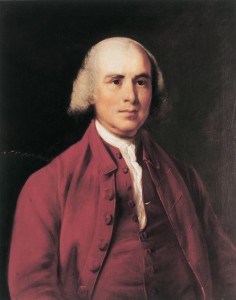
JamesMadisonAnd James Madison, known as “The Father of the Constitution” also had no children of his own. He married Dolley Madison, who had children from a prior marriage, and who, like Martha Washington, was a widow when she married James Madison. He helped raise her children, but again they had no children together. read more

George Washington as a Leader

Landsdowne paintingWhen the U.S. Constitution was ratified and George Washington was elected as the first President of the United States of America, not only was a new nation created, but also a new culture.
This new nation was based on the founding principles of honesty, human rights, and virtue. The nation provided as John Adams described it: “a light on a hill” for all to look to admire, and duplicate. There was an excellence for other nations, and peoples, to strive after.

The creation of the United State of America gave other nations an understanding that the United States of America is a place where people could be free. They would be free to practice their religion as they chose, free to think whatever was on their minds, and even free to speak those thoughts. read more

George Washington A Hero

GeorgeWashingtonI’m sure you’ve heard some of those strange stories that claim that my hero, George Washington got himself appointed Commander in Chief so that he could amass more wealth! Not at all true.

Instead of increasing his wealth, he actually lost much of it. As you will recall from your high school history class, he asked only that his actual out of pocket expenses be reimbursed. He wanted not pay, no salary.

It has been estimated that “Washington’s cumulative financial losses from the war—from neglect of his lands, noncollection from delinquent debtors and tenants, stoppage of exportation, and rapid depreciation of paper money—rose to some $120,000.00.” That’s more than $1 million in today’s money. Think about that. read more

George Washington and His Mother

GeorgeWashingtonIt’s not a tale usually told, but George Washington didn’t get along real well with his mother. He thought she was too controlling, too dominating, and too unpleasant around him. He always respected her and was honor bound to submit to her wishes.

George’s half-brother, Lawrence, was in the British Royal Navy. When he learned that the navy was looking for some more good men, he notified George. George thought that becoming a midshipman would let him engage in a life of adventure and would become glorious career. read more

Big Decisions

GeorgeWashington“Make big decisions in the calm.” That’s what Dwight D. Eisenhower said. As you know, he was the nation’s 34th President.

Dr. Seuss said it this way:
“Try to remember,
through thick and through thin,
when you give it your best,
why that’s when you win.”

Colonel Von Steuben said it this way to General Washington:
“To an American I am obliged to say, this is the reason why you ought to do that, and then he does it.”

Dorothea Brandt, a writer, put it this way:
“The key to success is to determine your goal and then act as if it were impossible to fail—and it shall be!” read more

A Note From George Washington

Landsdowne paintingBenjamin Franklin was aware that he was dying in 1790. He was cared for by his daughter, Sara Franklin Bache. One evening a knock came at the door. A messenger carried a letter from President George Washington.

Sara answered the door and announced the arrival of the message. Benjamin Franklin, who was by now half blind, said: “Sally (as he called his daughter) please read me the missive.”

She opened the note and this is what she read:

“If to be venerated for benevolence, if to be admired for talents, if to be esteemed for patriotism, if to be beloved for philanthropy, can gratify the human mind, you have the pleasing consolation to know that you have not lived in vain.” read more

George Washington and The Grand Old Flag

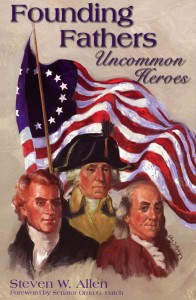
Founding Fathers coverBetsy Ross was a recent widow, and she was a poor, struggling seamstress when the story goes, she was approach by a team, including General George Washington to create a new flag for the hope of a new nation. It was apparently a secret meeting. General Washington asked her for help in the preparation of a brand new flag, and a new concept for a struggling nation.

Some historians doubt the story at least a little. Why? Because a man named Francis Hopkinson asked to be credited and paid for the production of the new flag. Who was Hopkinson? He was an author and a delegate to the Continental Congress from New Jersey. He asked to be paid for ‘his creation’. He actually wrote a letter to the Continental Board of Admiralty for a reward of two casks of wine for several patriotic designs he had created during the previous three years. read more

Washington’s Farewell Address

Landsdowne paintingWhen George Washington left office after serving two terms as President of the United States, he gave a Farewell Address. History says he didn’t actually deliver the speech, but had it printed and disseminated to Congress.

The speech was full of wisdom learned from his long experience as a leader of this country. For many years, decades, perhaps even centuries, this speech was required reading for Members of Congress—especially new members. The encouragement George gave in his talk had many religious overtones, and showed his true feelings about our nation. I think you should read it, perhaps every year! read more

Martha Washington – Be Cheerful!

Martha-Washington-by-Andrews“I am determined to be cheerful and happy in whatever situation I may find myself. For I have learned that the greater part of our misery or unhappiness is determined not by our circumstance but by our disposition.” –Martha Washington, First American First Lady, 1732-1802.

Martha met George Washington one day in late Autumn in 1758. She had been invited to dine at the home of Mr. Richard Chamberlayne, who was also a friend of George. Washington happened to stop by the home of his friend for supper while George was on his was to meet with the Governor in Williamsburg. read more