
Presidents Day

OLYMPUS DIGITAL CAMERASeveral years ago while I was a successful practicing attorney, I was looking through the morning newspaper. Yes, we still had one on home delivery in those days.

It was late in the month of January. I noticed there was an announcement for an upcoming sale for sheets and linens for Presidents Day. Later in the paper was an add for amazing sales on Ford automobiles at the local dealer. Likewise there were adds for specials for meals in honor of Presidents Day. But nowhere did I notice any local events, parades, or feasts being held in honor of either George Washington or Abraham Lincoln. read more

George Washington’s Perseverance

GeorgeWashingtonWashington was well known for sticking to a task that he had undertaken. He couldn’t be shaken from doing his duty, or fulfilling his promise.
After he had fought in the French and Indian War, served in the Virginia House of Burgesses, Served as Commander in Chief of the United Colonial Armies until he won the War, served as President of the Constitutional Convention, was unanimously elected, not once but twice as the President of the new United States of America, he finally wanted to return home to Mount Vernon to live out his life. The country wanted him to serve a third term as President, but he finally declined a job! He truly had served enough!! read more

George Washington Didn’t Quit

GeorgeWashingtonOne thing that the British are certain about is that General George Washington never quit. No matter how difficult the challenge, or how bad the weather, or how small the number of recruits, George carried on. He was after all the unanimously appointed Commander in Chief of the United Colonial Army.

He carried on courageously until Yorktown when he became the ultimate winner. What a war. But he still wasn’t finished.

I just read a story about another person who would quit. For some reason it made me think of all Washington had to endure. read more

President Washington’s Last Words

Earl Warren was born on March 19, 1891. He was appointed by President Dwight Eisenhower to become the 14th Chief Justice of the U. S. Supreme Court in 1953. In law school we read lots of his decisions on cases he adjudicated. He was a learned gentleman and usually kept a copy of the Constitution with him, in his suit pocket or his briefcase. He thought we all should study it. He passed away on July 9, 1974, the year after I graduated from Law School.

As he approached the age of 40, he changed his attitude on growing old. He seemed to be upset at reaching that milestone when an older friend of his tried to cheer him up. The advice from his friend was: “Don’t complain about growing old—many people don’t have that privilege!” read more

Benjamin Franklin’s Humility

Ben FranklinIn Benjamin Franklin’s Project for Moral Perfection he listed 13 characteristics that he wanted to improve during his lifetime. Yes, he wanted to become perfect. He had trouble with one of them and said:

“My list of virtues contain’d at first but twelve, but a Quaker friend having kindly informed me that I was generally thought Proud; that my pride show’d itself frequently in conversation; that I was not content with being in the right when discussing any point, but was overbearing, and rather insolent, of which he convinc’e me by mentioning several instances; I determined endeavoring to cure myself, if I could, of this vice or folly among the rest and I added humility to the rest.” read more

Lighten Up Says George!

“Why did the cat fall into the well?”

“I don’t know, why?”

“Because he couldn’t see that well!”

Dana Perino, Fox Five

Just thought you’d enjoy that!      GW Rules

“Just hoping you’re smiling,
delighted, content . . . .
And totally happy,

One hundred percent!”

Dr. Suess

SMILE!!

“If you Cough, Sneeze, Sigh, or Yawn, do it not Loud but Privately; and Speak not in your Yawning, but put your Handkerchief or Hand before your face and turn aside.” George Washington’s Rules of Civility. read more

George Washington and Walking Sticks

Landsdowne paintingIn the 1700’s walking sticks were all the rage in England. Everyone wanted one it seemed. The government, of course became quite worried. So there was a law passed that in order to stroll with the aid of a cane one had to purchase a license and abide by a strict set of rules.
It seemed that one of the rules prohibited the person with the stick from gesturing with or waving the stick in the air. He also could not hang the cane from his waistcoat, nor tuck it under his arm.

Gentlemen, being the gentle men that they were, seldom disregarded any of these rules. Thus there was never a cane mutiny. read more

Founding Fathers—Uncommon Heroes

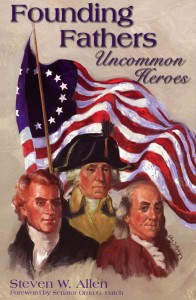
Founding Fathers coverThe Founding Fathers were patriots. The root word of ‘founding’ is ‘found’, which means to “take the first steps in building”. The first builders of the nation. The use of the word ‘father’ in this sense means originator. They began the whole thing.

In this context, a father is one who has become one of the leading men as of a country. Just like a man is a father to a boy. The originator, the starter, the one who sees it through.

The way we use these words together today refers to the men who were there at the beginning of our new nation. The ones who originated or started the process of building a new nation. Nation means a politically organized community. read more

George Washington According to Franklin

Ben FranklinThe story is told about a gathering of foreign ministers together for business and dinner a few years after the Revolutionary War. The British Ambassador presented his toast: “England—the sun, whose bright beams enlighten and fructify the remotest corners of the earth.”

Then the ambassador from France arose and gave his own toast: “France—the moon, whose mild, steady and cheering rays are the delight of all nations, controlling them in the darkness, and making their dreariness beautiful.” read more

Our Two Honest Presidents

GeorgeWashington“Oh, he’s a politician, you can’t believe anything he says!”

That’s what I heard the other day standing near a couple talking about the upcoming elections. It made me stop and think. Is that really what it has come to?

The story about George Washington and the cherry tree used to be taught in schools to help youngsters learn about honesty. Now it’s often pooh-poohed as a made up tale. The bloom is off the cherry tree—or at least it’s story.

Parson Weems, a regular at George Washington’s dinner table, wrote the story after George had passed away. It may be based
in fact. Parson may have heard it from George himself. (I’m not going to tell the story here, so for more on that tale, go to Founding Fathers—Uncommon Heroes, pages 39-41, if you’d like to read more about it). read more