Thomas Jefferson, Books and Learning

ThomasJeffersonOne of Thomas Jefferson’s personal characteristics was that he was a sponge for learning. Even as a youth he was so inquisitive that he was such a good student, the classes didn’t go fast enough for him.

He graduated college at William and Mary in Williamsburg, Virginia, and then continued to study law with George Wythe, who became the first law professor at that college. Wythe later became one of the signers of Jeffferson’s Declaration of Independence.

In Jefferson’s Monticello, his mansion near Charlotte, Tom kept several different locations available for him to sit and read and study at the drop of a hat. He wrote to John Adams: “I cannot live without books.” His collection of books exceeded that of the Congressional Library, which was burned  in the War of 1812, and replaced by Jefferson in 1814. read more

The Founding Fathers and the World Series — NY Mets? KC Royals?

Polo Grounds during World Series Game, 1913 from the Bain Collection by David Shapinsky from Washington, D.C.

Polo Grounds during World Series Game, 1913 from the Bain Collection by David Shapinsky from Washington, D.C.

There’s still argument over the actual beginning of baseball in the United States, but the World series didn’t actually begin until the early 1900’s. So it’s clear that our Founding Fathers would not have been interested in the World Series, or even known of it.

But if we could consider it, who would the Founding Fathers root for in a game. In today’s world series, George Washington would, of course, root for the New York Mets, having served as President in New York — Washington, DC was still on the drawing board. Although he was a great horseman and didn’t have professional sports in those days, I think he would like the game of baseball. read more

Jefferson and Listening

ThomasJeffersonThomas Jefferson served with Patrick Henry and George Washington in the House of Burgesses. He served later in the Continental Congress with Benjamin Franklin. One thing Jefferson learned from these three men, and especially Franklin and Washington, was how to listen. George was especially adept at this trait.

Jefferson made it a point not to argue and to try to be a peacemaker. Of his experience in Congress he wrote in his autobiography:

“Our body was a little numerous, but very conscientious. Day after day was wasted on the most unimportant questions. A member, one of those afflicted with the morbid rage of debate, of an ardent mind, prompt imagination, and copious flow of words, who heard with impatience any logic which was not his own, sitting near me on some occasion of a trifling but wordy debate, asked me how I could sit in silence, hearing so much false reasoning, which a word would refute? I observed to him, that to refute indeed was easy, but to silence was impossible.” read more

Freedom, Founding Fathers, and The Trial of Christ

HeaderIt’s hard to explain, especially in just a few words, but I’ll try. People always ask me why I wrote my books in such seemingly different areas or topics.

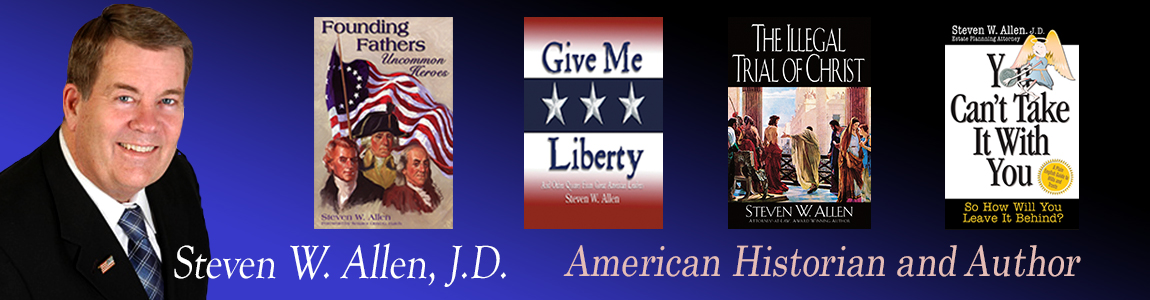
My first book, “Founding Fathers—Uncommon Heroes” is a book with chapters about six of our Founding Fathers. Men who had the courage to establish the United States of America. The six men are Benjamin Franklin, George Washington, John Adams, Thomas Jefferson, Patrick Henry, and James Madison.

My second book, “The Illegal Trial of Christ,” came at the request of my publisher, who knew I gave popular presentations about this topic. This book includes biographical information about the many players involved in the four trials that took place at the end of Christ’s life. In this book I also explain some of the rules, procedures, and laws in effect at that time. Both Roman law and Hebrew law. By understanding these people and their circumstances, readers will come to recognize and grasp why some things are worded the way they are in the four Gospels. read more

Favorite Founding Father

Ben FranklinI have given many presentations about the Founding Fathers. I am the author of “Founding Fathers –Uncommon Heroes.” As I have spoken, many have asked “Who is your favorite Founding Father?”

That’s such a difficult question, I answer: “When I am speaking about George Washington, he’s my favorite. When I am talking about Thomas Jefferson, he’s my favorite. When I speak about Patrick Henry, he’s my favorite. When I am discussing John Adams, he’s my favorite. And when I speak about James Madison and Dolley Madison, they are my favorites.” read more

Founding Fathers and Humility

Scene_at_the_Signing_of_the_Constitution_of_the_United_StatesThis is a quote that reminds me of George Washington, Thomas Jefferson, Benjamin Franklin, and others of our Founding Fathers—Uncommon Heroes:

“Something Very Beautiful happens to a people when their world has fallen apart: A Humility. A Nobility. A Higher Intelligence Emerges at just the point when our knees hit the Floor.” –Marianne Williamson

The world had fallen apart for these men, and they came to the rescue with humility, nobility, and a belief in the support of a Higher Intelligence. Their knees often hit the floor. read more

Benjamin Franklin, Government and Daylight Savings Time

Ben FranklinWise old Benjamin Franklin made lots of discoveries. But I have to say that one of them makes no sense at all today. In Ben’s day during the winters the cost of candles was one of the major expenses. So Ben came up with the idea of “Daylight Savings Time.” They would use the longer days to save themselves the need to keep the candle burning. It caught on.

But today, does it still make any sense, what with light bulbs and electricity and all our conveniences? Why do we need the trouble of changing the time on our electric clocks? Spring forward, fall back. But why now? It no longer makes any sense. read more

Benjamin Franklin for 2nd Graders

Founding Fathers coverI have been invited by my grandson, Garrett’s second grade teacher to speak to his class about the Founding Fathers. Garrett told his teacher that his granddad had written a book. She wanted to see it, so he gave her one.

She has really enjoyed reading it, and so asked Garrett’s mother if she would talk to me about coming to speak to their class. She did and I accepted. Then it turns out that this teacher has invited not only her class but all the 2nd grade classes in the school to join in my presentation. That means there will be more than 100 second graders in the audience. read more

U. S. History Patriotic Artwork

When I retired and closed my law office a few years ago, I had to bring my office artwork home. That included about 8 or 10 beautiful patriotic oil paintings, reproductions, art posters, and even plaster busts of George Washington, Benjamin Franklin, and Thomas Jefferson. And a full sized American flag on a pole.

Our home already had its own artwork on nearly every available wall, and this artwork didn’t really lend itself all that well to a family residence. So all the artwork was just stacked up near a wall in the back room. I couldn’t stand to part with such lovely pieces which I had become so accustomed to at work. So what to do? It can’t continue to still just languish there where it is! read more

John Adams and Thomas Jefferson Teach Each Other

History is full of fascinating facts! Here’s just one example:

Thomas Jefferson, from Virginia, and John Adams from Massachusetts, became fast friends during the Continental Congress in Philadelphia. It was here that Tom wrote the Declaration of Independence in only 17 days without book or pamphlet, while residing at the Graff House.

When Tom’s draft was presented to the Congress, Tom did not speak on its behalf, on behalf of his immortal document. Tom was not a very good public speaker. His voice was high and shrill and barely audible to a group. read more