C. S. Lewis and Christianity

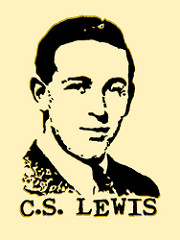
445192825_011af775a5_mMost people know C. S. Lewis as the author of “The Chronicles of Narnia” and that he wrote some other stuff about Christianity. But few know that he was at first an atheist. Through experiences in his life he became a Christian.

He wanted others to be able to find the same things he did, so he held a series of radio broadcasts in 1942 to 1944 about the Christian Faith he had by then endorsed. These speeches were gathered into a book titled “Mere Christianity.” It was addressed to people at war, and contains some amazing insights. read more

George Washing Looking Back

GeorgeWashingtonGeorge was an indispensable man in history. He had something to say about looking back:

“We ought not to look back unless it is to derive useful lessons from past errors, and for the purpose of profiting by dear-bought experience.”

John Adams added:

“Facts are stubborn things; and whatever may be our wishes, our inclinations, or the dictates of our passion, they cannot alter the state of facts and evidence.”

As you know, John Adams was the attorney who argued in defense of the British soldiers in the Boston Massacre trials. (If you didn’t know that then perhaps you would like to read the book “Founding Fathers—Uncommon Heroes.”) read more

James Madison and Politics

JamesMadisonAs you know, James Madison is known as “The Father of the Constitution.” He was very knowledgeable and astute when it came to governments. He also had an idea about what to look for in your government leaders. This is how he described his philosophy:

“The aim of every political constitution is, or ought to be, first to obtain for rulers men who possess most wisdom to discern, and most virtue to pursue, the common good of society; and . . . to take the most effectual precautions for keeping them virtuous whilst they continue to hold their public trust.” read more

Patrick Henry’s Claim to Fame

PatrickHenryMost people today don’t know very much about Patrick Henry. Through my study of the Founding Fathers, he has become one of my favorites. He had much to say to us and to do for us. Not the least off which was his example of good character.

Perhaps a fitting epitaph of this amazing man is the one paid to him by his grandson who described Henry as always setting “a good example of honesty, benevolence, hospitality and every social virtue. He assisted in the education of his . . . children and especially devoted much time to earnest efforts to establish true Christianity in our country.” read more

Governor Patrick Henry, Give Me Liberty . . .

PatrickHenryI can recall a time after High School, when I could sort of remember the name of Patrick Henry. I even knew that he gave a monumental talk at some point in his life where he said the words: “Give me liberty . . . or give me death!”

I didn’t know when he gave that speech, or where it occurred. But I seemed to think it was sometime around the Civil War period. As you can guess, history was not my favorite subject in High School.

Then in 1976, yes, 1976, as a young attorney, I was elected to represent a Phoenix Mayor’s committee at a National Convention of Citizens Crime Commissions, to be held in Philadelphia, Pennsylvania that year. For those of you who weren’t around then, that was our Nation’s Bi-centennial celebration of the adoption of our Declaration of Independence. read more

Happy Halloween, Greet Thanksgiving

800px-Mtchoirandorchestra_ConferenceCenter_(cropped)They didn’t have Halloween celebrations or trick or treating in the early days of our nation. No masquerade balls, or trunk or treating either.

But they did begin to get ready for Thanksgiving. I hope that’s what we all will do now. It will be here quickly!

“The greatest saint in the world is not he who prays most or fasts most; it is not he who gives alms, or is most eminent for temperance, chastity, or justice. It is he who is most thankful to God, and who has a heart always ready to praise Him.” –William Law read more

Thomas Jefferson, Books and Learning

ThomasJeffersonOne of Thomas Jefferson’s personal characteristics was that he was a sponge for learning. Even as a youth he was so inquisitive that he was such a good student, the classes didn’t go fast enough for him.

He graduated college at William and Mary in Williamsburg, Virginia, and then continued to study law with George Wythe, who became the first law professor at that college. Wythe later became one of the signers of Jeffferson’s Declaration of Independence.

In Jefferson’s Monticello, his mansion near Charlotte, Tom kept several different locations available for him to sit and read and study at the drop of a hat. He wrote to John Adams: “I cannot live without books.” His collection of books exceeded that of the Congressional Library, which was burned  in the War of 1812, and replaced by Jefferson in 1814. read more

Freedom, Founding Fathers, and The Trial of Christ

HeaderIt’s hard to explain, especially in just a few words, but I’ll try. People always ask me why I wrote my books in such seemingly different areas or topics.

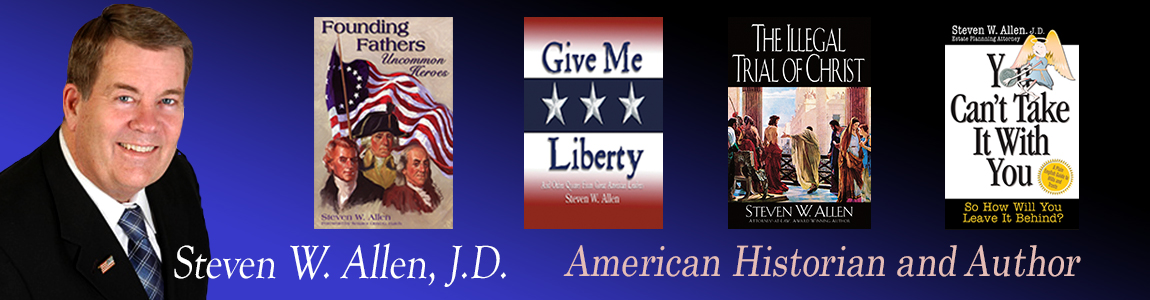
My first book, “Founding Fathers—Uncommon Heroes” is a book with chapters about six of our Founding Fathers. Men who had the courage to establish the United States of America. The six men are Benjamin Franklin, George Washington, John Adams, Thomas Jefferson, Patrick Henry, and James Madison.

My second book, “The Illegal Trial of Christ,” came at the request of my publisher, who knew I gave popular presentations about this topic. This book includes biographical information about the many players involved in the four trials that took place at the end of Christ’s life. In this book I also explain some of the rules, procedures, and laws in effect at that time. Both Roman law and Hebrew law. By understanding these people and their circumstances, readers will come to recognize and grasp why some things are worded the way they are in the four Gospels. read more

Thomas Jefferson’s Private Religious Projects

ThomasJeffersonIn his later years, Thomas Jefferson decided to compile what he understood to be Jesus Christ’s own words from the New Testament. Here is what he actually said about this venture:

“I too have made a wee little book . . . which I call “The Philosophy of Jesus.” It is made by cutting the texts out of the book and arranging them on the pages of a blank book, in a certain order of time and subject. A more beautiful or precious morsel of ethics I have never seen. It is a document in proof that I am a real Christian, that is to say, a disciple of the doctrines of Jesus, very different from the Platonists, who call me an infidel and themselves Christians and preachers of the gospel, while they draw all their characteristic dogmas from what its Author never said or saw. They have compounded from the heathen mysteries a system beyond the comprehension of man, of which . . .were He to return on earth would not recognize one feature.” read more