
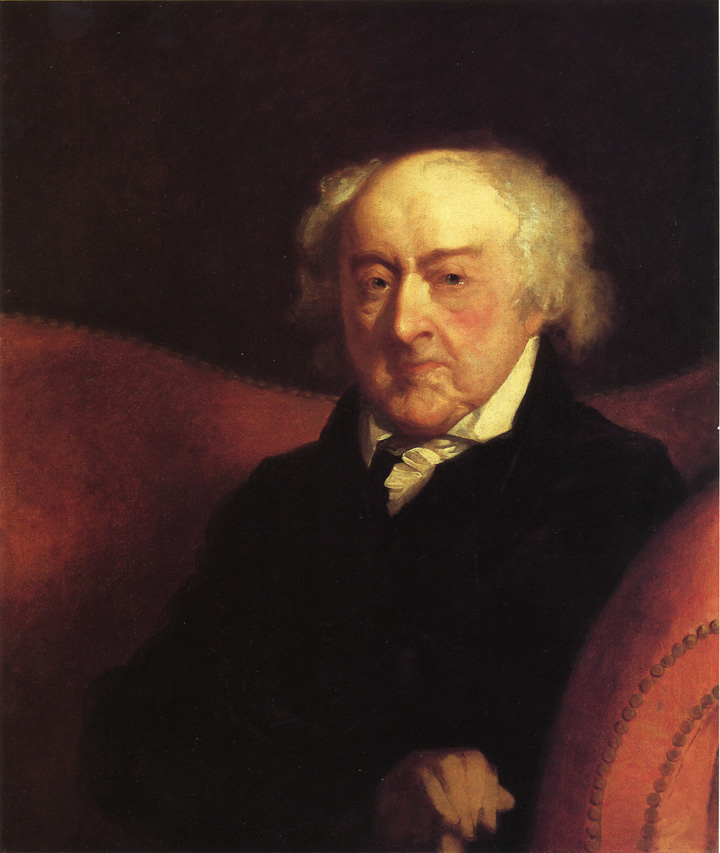
 Shortly after the Declaration of Independence was adopted by Congress, Adams was sent to France to join Benjamin Franklin as a minister to France. Congress didn’t invite him to return home, even after the Revolutionary War had ended, and he and Franklin had constructed a Peace Treat, very much in favor of the United States.
Instead they sent him to Great Britain to attempt to produce a treaty of commerce with England. Can you imagine that? To try to put together a new treaty with your most recent war enemy? Impossible. Well, at least terribly difficult.
At that time, of course, the United States, after winning the Revolutionary war, was in danger of collapsing because of the inadequacy of the Articles of Confederation. James Madison had been successful in stimulating representatives of the various States to come together to draft some amendments to these Articles.
John Adams urgently wanted to be there with his compatriots to form the new document. Adams was already the drafter of the new State Constitution for the State of Massachusetts. But no. He had to remain in England to do the bidding of Congress.
Feeling desperate to accomplish something, John Adams made this monumental decision. He would write a book! Every victory he had ever had had come through the word: either spoken or written. He wanted to prove through his writing that only a balanced system of government, with a strong central executive, two separate legislative bodies, and a judiciary, would keep the republic alive.
John wanted to have his book ready for consultation by those elected to begin this process. He would call it “A Defence of the Constitutions of Government of the United States.”
Unbelievably, almost miraculously, Adams book, a two volume set, was ready in time for use by the men attending this new Constitutional Convention. It was printed by spring, 1787, and was used by most of those attending the Convention. It proved to be an invaluable asset, and gave direction to the arguments in preparation of the new Constitution.
One historical scholar noted: “Even a casual glance at the records of the Federal Convention will show that Adams’ book was used as a sort of repertory by many speakers, who found in it a confirmation of their views, [with] historical illustrations and precedents.” (As quoted in “Founding Father—Uncommon Heroes” by Steven W. Allen, page 105.)
Many have forgotten how important John Adams was to our history.
-

By: Steven W. Allen, J.D.
Steven W. Allen, J.D. is an author, speaker, and retired attorney. His book “Founding Fathers – Uncommon Heroes” is popular with all ages and is used in many schools. See his other books at www.StevenAllenBooks.com
-


-
The Federalist Papers
Constitutional Amendments
Founding Fathers and American Heroes
Founding Fathers and War
What About Benedict Arnold?
Books and Founding Fathers