
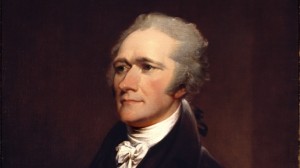
 In the last few blogs, I have focused a little on Washington and the Battle of Trenton. The miraculous battle was immortalized by that painting of Luetze of Washington crossing the Delaware. You’ll remember that in that battle Alexander Hamilton was one of the young soldiers who helped create the victory.
What is often missed is that Washington didn’t stop there with that one decisive victory at that most important time in history. He decided on another stunning foray against the British who were camped at Princeton, New Jersey.
On January 3, 1777, Washington was able to re-invigorate his troops for an equally decisive assault on the Redcoats now resting at the nearby camp in Princeton. At this seemingly minor, but successful and inspiring triumph, his men routed the British and rounded up nearly 200 British prisoners.
“It’s a fine fox chase, my boys!” Washington exclaimed to his troops. One of the senior officers recalled Hamilton and his company marching into the village: “I noticed a youth, a mere stripling, small, slender, almost delicate in frame, marching beside a piece of artillery, with a cocked hat pulled down over his eyes, apparently lost in thought, with his hand resting on a cannon, and every now and then patting it as if it were a favorite horse or a pet plaything.”
Important people were now taking notice of this young man. “Well, I do recollect the day when Hamilton’s company marched into Princeton. It was a model of discipline. At their head was a boy and I wondered at his youth, but what was my surprise when that slight figure was pointed out to me as that Hamilton of whom we had already heard so much.”
Alexander Hamilton had previously been denied acceptance into Princeton college, so this victory was very satisfying to this young man. There is a story that claims that Hamilton set up one of his cannon in the college yard, pounded the brick building, and sent a cannonball through a portrait of King George II in the chapel.
We do know for certain that the British soldiers inside surrendered to Washington and his company. That brought about new feelings of courage and hope, because the Continental Army had outwitted the well-trained British troops
With these two victories, General George Washington saved Philadelphia from attack by the British, and they gained several months to restore the nearly depleted Army. Washington moved his troops to Morristown, New Jersey some 30 miles from New York.
When a vacancy appeared on Washington’s staff, Hamilton was in an excellent position to fill it. And that he did. The boy “genius” had now been discovered by four generals; Alexander McDougall, Nathaniel Green, Lord Stirling, and even General George Washington himself. His promotion was advocated by none other than Henry Knox, the artillery commander of the Continental Army and Hamilton’s immediate superior.
The 300 pound Knox was a jubilant and delightful man with a rotund nose and an indelicate sense of humor. He had been a Boston book-seller when Washington befriended him and made him an important part of his army.
Just a few weeks after this victory at Princeton, Hamilton was advanced to the rank of lieutenant colonel and was encamped near Washington.
-

By: Steven W. Allen, J.D.
Steven W. Allen, J.D. is an author, speaker, and retired attorney. His book “Founding Fathers – Uncommon Heroes” is popular with all ages and is used in many schools. See his other books at www.StevenAllenBooks.com
-


-
The Federalist Papers
Constitutional Amendments
Founding Fathers and American Heroes
Founding Fathers and War
What About Benedict Arnold?
Books and Founding Fathers