Connecticut Yankees

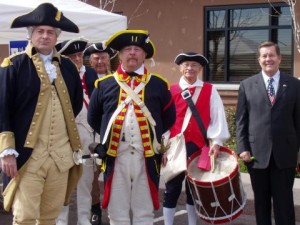
OLYMPUS DIGITAL CAMERAToday the citizens of Connecticut will vote in their primary elections. Did you know that the State anthem of Connecticut is “Yankee Doodle”? I didn’t.

That is a very interesting song with a fascinating history. It was sung by the British during the French and Indian War to signify that the colonists weren’t very good soldiers. Not disciplined, not brave, not very smart.

Yankee Doodle went to town
A ridin on a pony.
Stuck a feather in his cap and called it macaroni. Etc. Etc.

It was later sung by the British in the Revolutionary War to indicate their disdain for the rebels. Then it was adopted by some of the Revolutionary Soldiers, to throw it back in the face of the Redcoats. read more

George Washington and Walking Sticks

Landsdowne paintingIn the 1700’s walking sticks were all the rage in England. Everyone wanted one it seemed. The government, of course became quite worried. So there was a law passed that in order to stroll with the aid of a cane one had to purchase a license and abide by a strict set of rules.
It seemed that one of the rules prohibited the person with the stick from gesturing with or waving the stick in the air. He also could not hang the cane from his waistcoat, nor tuck it under his arm.

Gentlemen, being the gentle men that they were, seldom disregarded any of these rules. Thus there was never a cane mutiny. read more

Ben Franklin, Rainy Days and Libraries

Ben Franklin thumb picture

Benjamin Franklin credited libraries with turning common tradesmen into smart citizens. Especially on rainy days. Ben said it this way: “our people having no publik amusements to divert their attention to study, became better acquainted with books.” They didn’t have anything else to do on days with bad weather, rainy days.

Franklin began the first circulation public library in 1731 in Philadelphia, actually in all of North America. It soon caught on. Similar libraries were formed by other do good citizens in all the colonies. read more

Service Club with Benjamin Franklin

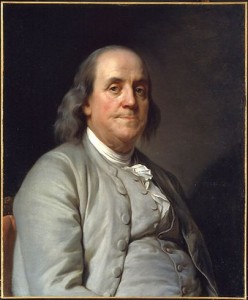
Ben FranklinHey, how would you like to have been in a service club with our Founding Father, Benjamin Franklin? Wouldn’t that have been great? He was a learned man, and you could learn much from him and his experience.

Benjamin Franklin founded “the Leather Apron Club,” more formally known as the Junto, in 1727, in Philadelphia. This was a forerunner of today’s types of service clubs such as Rotary, Kiwanis, Lions, and Optimists clubs. It was intended to provide a place where friends could come to learn from each other and help others as well. read more

Doctor Franklin

Ben Franklin thumb pictureI can remember being told sometime shortly after my receipt of my diploma for the grade of Juris Doctor (Doctor of Laws), that doctors were originally mostly lawyers! Well, we’re not to be confused with doctors of medicine. But the original doctor degrees were first issued to lawyers, doctors, and, of all things, religious leaders.

Nevertheless, Benjamin Franklin was often referred to as Doctor Franklin. I didn’t wonder about that too much until I started studying Dr. Franklin’s life. I learned that Benjamin Franklin received an honorary master’s degree from the College of William and Mary in 1756. He also received honorary DOCTOR degrees from across the Atlantic, the University of St. Andrews in 1759, the University of Oxford in 1762. And he also received doctorates from America’s oldest universities, Yale and Harvard. And then again from the College of William and Mary. read more

Death and Taxes

Ben Franklin thumb pictureIn honor of this Tax Day in these United States, I leave only a quote from Benjamin Franklin:

“In this world nothing can be said to be certain, except death and taxes.”

Of course you’ve heard that one, but have you heard this quote from him? He was once asked if our country should ever have income or direct taxation. (You know that was unconstitutional until 1913 and the sixteenth Amendment).

“His response was immediate and direct: “No. An income tax will make liars out of the people and a despot out of the government.” read more

Thomas Jefferson’s Birthday!

ThomasJeffersonThomas Jefferson should truly be remembered and honored today. What did he accomplish? I’ll just mention a few here. He graduated from William and Mary College and then studied law for 5 years under George Wythe, the first law professor in Virginia.

By then he was already an accomplished violinist and dancer. He fell in love with and married another musician, Martha Wayles Skelton. He had already begun construction on Montecello, so they moved in to the one room that was finished there. He worked on building and remodeling for the next 40 years. (If you haven’t been there, you should go to visit and to observe the detail and the beauty of his mansion on the hill. read more

Jefferson’s Suggested News Categories

ThomasJeffersonThomas Jefferson suggested that editors divide their newspapers into four sections: Truths, possibilities, possibilities and lies.

The General Advertiser in London published a story in 1747 that was soon picked up by some newspapers in the American colonies. It wrote that a woman named Polly Baker from New England, was being prosecuted for giving birth to an illegitimate child. This was the fifth time she had apparently been guilty of the same offense.

Her defense to the judges had been that she had simply been obedient to the “first and great commandment of nature, and of nature’s God, ‘increase and multiply’” She reasoned how could it be a crime to “add to the number of the King’s subjects in a new country that really wants people?” read more

What? A Violent Benjamin Franklin?

Ben Franklin thumb pictureFranklin, of course, was first a printer. And a good one at that. Of course he needed things to print in his newspaper. He loved good stories. He even made some up—especially to discourage the British in the Revolutionary War.

Did he go too far? Only you can decide. In 1789, the year before Ben died, a newspaper article was printed in which Ben is reported to have said:

“My proposal, then, is to leave liberty of the press untouched, to be exercised in its full extent, force and vigor, but to permit liberty of the cudgel (which is a short and heavy club, for those of you who can’t remember your high school English) to go with it . . . .Thus, my fellow citizens, if an impudent writer attacks your reputation, dearer to you perhaps than your life, you may go to him openly and break his head.” (Clarence S. Brigham, Journals and Journeymen, Philadelphia: University of Pennsylvania Press, 1950, page 69. Emphasis omitted, spelling and capitalization modernized. read more