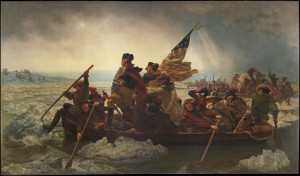
 In his youth, George Washington developed faith. He was very private about his faith. During the Revolutionary War his soldiers Knew he often went into the trees to be alone in prayer, or sometimes he knelt in his officers quarters. But George was private about his beliefs, usually referring to “the hand of Providence” when he knew he had been protected by God.
Faith to him was a private thing. Faith required no proof.
Or as Emily Dickinson put it:
“I never saw a moor,
I never saw the sea,
Yet know I how the heather looks,
And what a wave must be.
 On top of that I received some treasured gifts from my wife and from my daughters. I won’t tell you which are from which one lest the others feel slighted. But I got a See’s candy gift card, and four different good books. “First Freedom, a Fight for Religious Liberty” by Randall Balmer, Lee Groberg, and Mark Mabry (full of beautiful pictures in addition to the words). “America in the Last Days, The Constitution and the Signs of the Times” by Morris Harmor. “John Quincy Adams” by Harlow Giles Unger. And “Dreamers and Deceivers, True Stories of the Heroes and Villains Who Mad America”, by Best Selling Author, Glenn Beck.
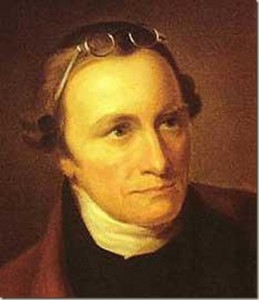 Patrick Henry didn’t like the U.S. Constitution. He spoke out forcefully against its adoption in the Virginia Constitutional Convention. He spoke nearly every day –18 of the 23 days of the Convention, arguing against its adoption. Why didn’t he like it, you ask? It wasn’t because he was not a true patriot. He was known as America’s first patriot.
 It surely reminded me of a couple of the Rules of Civility and Decent Behaviour in Company and Conversation that George Washington had to write over and over again to learn good penmanship. I thought perhaps we should return to learning that way.
 Looking back on it, many would agree that the two Amendments to the U.S. Constitution which were both ratified in 1913, were the worst Amendments ever adopted (some say they weren’t actually properly ratified). Those were the Sixteenth and Seventeenth Amendments.
 Thomas Jefferson was a true Christian as he said himself. He was so interested in the teachings of Christ that he used his language skills to cut out and place the 4 books of the New Testament Gospels (Matthew, Mark, Luke, and John) side by side in 4 different languages (in which Tom himself was proficient, of course) so that he could see for himself the minute differences rendered in each language.
 t’s hard for me to write anything negative about Thomas Jefferson, I love him so much and admire him for what he has given us. Jefferson taught others not to spend your money before you have it, to save and be frugal. Yet he didn’t seem to listen to his own advice in that regard.
 “Each of us was given a portion of God’s light, called ‘the Light of Christ,’ to help us distinguish between good and evil, right and wrong. This is why even those who live with little or no knowledge of the Father’s plan can still sense, in their hearts, that certain actions are just and moral while others are not.
 John Adams was creative and artistic in his use of words. He once explained to Abigail that he wanted to write a book to express his feelings and knowledge about the new Constitution which was being written while he was a diplomat to Great Britain.