John Adams and the Declaration of Independence

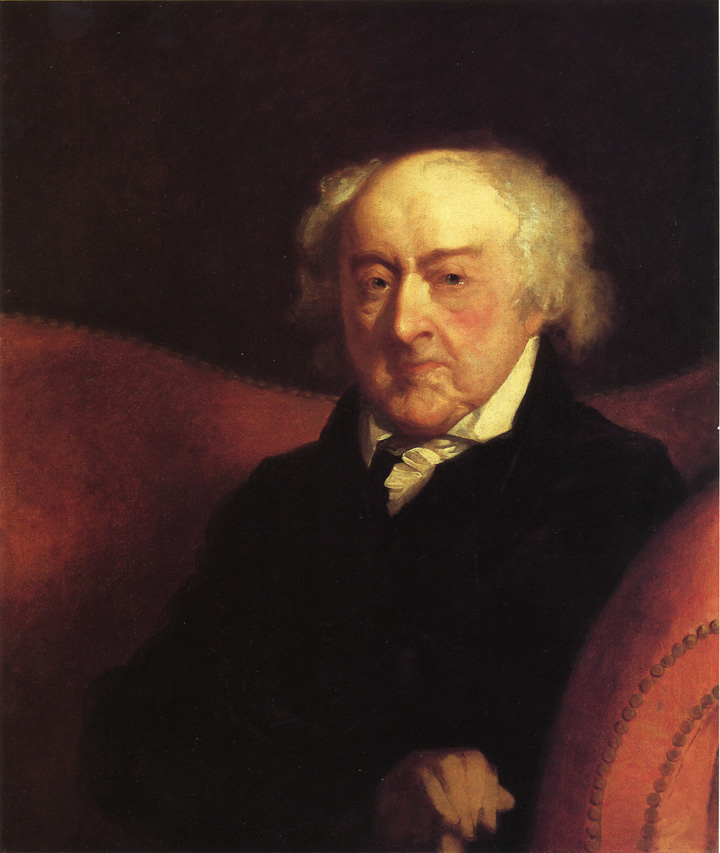
JohnAdamsJohn Adams, a lawyer, was truly at the front of the happenings of the Revolution with England. He wrote the pamphlet that had wide circulation and among others, caught the eye of Patrick Henry prior to his own Give Me Liberty speech.

John was a minister to France capturing a loan from Amsterdam which pretty much saved the Colonies in the war. He became the second President of the United States of America, upon the retirement of General George Washington.

What we sometimes forget about John is that he was the one who defended Thomas Jefferson’s draft of the Declaration of Independence at Philadelphia in 1776. Tom called him the “Colossus” for his vigorous defense. He carried the day and the Declaration was adopted. read more

The Least Known Founding Father

PatrickHenryIn speaking around the country, I am surprised to find that the least know of the Founding Fathers is Patrick Henry. Sure, people have heard of him, but know nothing about his life. Some people know he gave a speech once where he said those immortal words: “Give me Liberty or Give me Death!” Where and when and why no one seems to know. Some even think it was around the time of the Civil War.

Patrick Henry gave many speeches. Not the least of which was the first speech he gave as a newly elected member of the House of Burgesses, the civilian legislature approved by the Crown of England. It was that speech that Thomas Jefferson said lighted the light of liberty in his breast, never to be quenched. He was first a close friend of Thomas Jefferson, and during the Revolutionary War they became estranged enemies. read more

Thomas Jefferson’s Private Religious Projects

ThomasJeffersonIn his later years, Thomas Jefferson decided to compile what he understood to be Jesus Christ’s own words from the New Testament. Here is what he actually said about this venture:

“I too have made a wee little book . . . which I call “The Philosophy of Jesus.” It is made by cutting the texts out of the book and arranging them on the pages of a blank book, in a certain order of time and subject. A more beautiful or precious morsel of ethics I have never seen. It is a document in proof that I am a real Christian, that is to say, a disciple of the doctrines of Jesus, very different from the Platonists, who call me an infidel and themselves Christians and preachers of the gospel, while they draw all their characteristic dogmas from what its Author never said or saw. They have compounded from the heathen mysteries a system beyond the comprehension of man, of which . . .were He to return on earth would not recognize one feature.” read more

Christopher Columbus, George Washington, and Perseverance

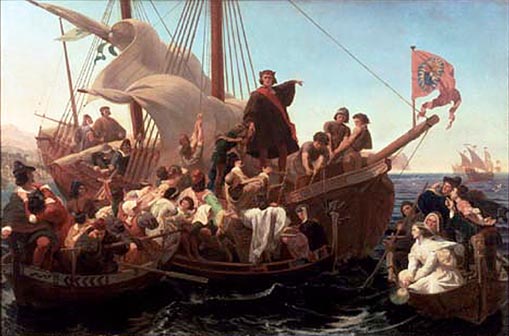
Christopher_Columbus_on_Santa_Maria_in_1492.Happy Columbus Day! Christopher Columbus and George Washington had many character traits in common. The most remarkable is Perseverance.

Columbus had an idea about reaching the East by sailing West. No one had successfully done that before. He was an expert sailor and mapmaker. He came up with his plan and presented it to the King of Portugal, the King and Queen of Spain—four times, the King of France, and he even sent his brother to England to present his plan.

He was on his way to present his plan once again to the King of France, when he was called back to the Majesties of Spain once again. They had just won their war in Grenada and now his plan sounded better to them. One more presentation and it was granted and approved. read more

U. S. History Patriotic Artwork

When I retired and closed my law office a few years ago, I had to bring my office artwork home. That included about 8 or 10 beautiful patriotic oil paintings, reproductions, art posters, and even plaster busts of George Washington, Benjamin Franklin, and Thomas Jefferson. And a full sized American flag on a pole.

Our home already had its own artwork on nearly every available wall, and this artwork didn’t really lend itself all that well to a family residence. So all the artwork was just stacked up near a wall in the back room. I couldn’t stand to part with such lovely pieces which I had become so accustomed to at work. So what to do? It can’t continue to still just languish there where it is! read more

John Adams and Thomas Jefferson Teach Each Other

History is full of fascinating facts! Here’s just one example:

Thomas Jefferson, from Virginia, and John Adams from Massachusetts, became fast friends during the Continental Congress in Philadelphia. It was here that Tom wrote the Declaration of Independence in only 17 days without book or pamphlet, while residing at the Graff House.

When Tom’s draft was presented to the Congress, Tom did not speak on its behalf, on behalf of his immortal document. Tom was not a very good public speaker. His voice was high and shrill and barely audible to a group. read more

James Madison and The U. S. Constitution, Then and Now

constitutionAfter 16 weeks of unrelenting work, the U. S. Constitution was signed on September 17, 1787. It was truly a miracle! Those who attended the Convention worked hard, studied hard, listened hard to others, and even prayed hard. They knew what they were doing was important for the centuries.

James Madison, known as the Father of the Constitution, had remarkable success in bringing together the most influential and wise men in the colonies, including George Washington, who didn’t want to be there at first. read more

The Constitution, American History and Economics

Just thought you’d like to know about how you can get a little more learnin’. You know, things about George Washington, James Madison, Patrick Henry, and important documents like the Declaration of Independence, the U.S. Constitution, the Bill of Rights, and much more.

Hillsdale College has more than 830,000 students enrolled in its free online courses, covering topics such as the Constitution, the principles of free-market economics, American history, the Western Heritage, and more. These courses are transformative—they can and will have a profound effect on the future of our country, especially at such a time as this. read more

The Shot Heard ‘Round the World

On April 18, 1775, the British General Gage decided to send 700 British soldiers to march on April 19, to Concord, Massachussets, to capture two prominent rebels: John Hancock and John Adams, who were hiding in that area. He was also determined to capture the munitions and guns that were then assembling in Lexington.

Joseph Warren, an American Patriot, heard of these plans and so he alerted two speedy couriers to watch for his signal and ride to warn and alert the Minutemen in those towns. The riders were Paul Revere and William Dawes. They were joined by Dr. Prescott. Revere was arrested, his horse confiscated, and he was released. So he actually got to Concord too late. But Dr. Prescott gave the warning that “the British are coming!” read more

The Battle of Trenton — Did You Know?

I’m sure you’re familiar with the miraculous march to the Battle of Trenton on Christmas Night in 1776. Everyone loves that beautiful painting of Washington crossing the Delaware. He was on his way to stealthily approach that city where the major force of the Hessian soldiers were encamped, along with the British.

Although we love that painting, it is technically not correct in all its details. For example, George Washington never would have stood up in such a precarious position while crossing that river with its ice floes floating so swiftly. And at that date there was no American flag as so prominently positioned in the boat. read more