Benjamin Franklin—Wise Friend

After the Declaration of Independence had been written, argued, agreed upon and signed, Benjamin Franklin was sent by Congress to seek to negotiate a loan from the King of France. This was needed to keep the Revolutionary Army of George Washington in service.

At the same time, Franklin’s friend, John Paul Jones was in Le Havre asking the French King for some warships. Jones’ written letters were to no avail.

Benjamin Franklin prepared to sail back to Pennsylvania after his loan was granted and a treaty with France were finally signed. read more
Snoopy and Constitution Day

constitutionYesterday was Constitution Day. Everyone I asked, never knew it was a special day at all, much less Constitution Day. Well, I guess that’s to be expected. Schools don’t pay much attention to the Constitution, because they seem to be too busy with optional gender bathrooms. Opps. Forget I said that.
It’s a little too much like the Peanuts comic strip where Schroeder is carrying a sign that reads: “Only 22 more days until Beethoven’s birthday.” He walks past Charlie Brown with that sign. read more

Theology and Democracy or Republicanism

Thomas Jefferson’s words in the Declaration of Independence should be given great attention in the United States today. As a lawyer, I consider the Declaration of Independence to be analogous to a new companies “Articles of Incorporation” or “Articles of Association” for an LLC.

Those are the documents that create a new company to be guided by the purposes described in such a document. The U.S. Constitution is analogous to the By-laws or Operating Agreement of the new company. They describe how is will be managed. read more

Did You Know This About the Constitution?

Who was Gouverneur Morris?

Was he a Governor of some State or Colony? What did he do that I should even know who he was?

No, that’s not a misspelling. That’s how he spelled his name—Gouverneur. And he pronounced it “Goo-ver-newer”.

constitutionNo, he was not a Governor at the time. He was one of the important men attending the Constitutional Convention in Philadelphia, Pennsylvania in 1787. He was one of the important men, at that Convention, such as James Madison, George Washington, Alexander Hamilton and Benjamin Franklin. read more

Americans Must Vote

constitutionThe Declaration of Independence together with the United States Constitution created a government never before seen by man on this earth. It is a government of the people and by the people. The people have a mandate to chose their own leaders. To vote!

This election is about who will sit on the Supreme Court, as much as it is about who will be President of the United States. After all, Supreme Court Justices are appointed for life—no elections, no impeachments. A President presides for 4 years, or perhaps 8. Justices may serve for 10, 20 or 30 years. For life, or until they choose to retire, as did Justice Sandra Day O’Connor. read more

Founding Fathers

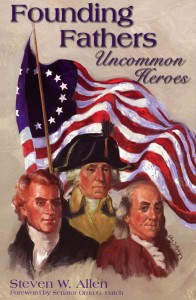
Founding Fathers coverHere are just a few words I think you should be familiar with. Are You?

Founding—those who take the first steps in building.
Fathers—to make oneself the founder, producer, or author of.
Uncommon—not ordinarily encountered, unsusual.
Heroes—exhibiting or marked by courage and daring.
Colonists—member or inhabitant of a colony.
Colony—a body of people living in a new territory but retaining ties with the parent state.
Farmers—a person who cultivates land or crops or raises livestock.
Mechanics—a manual worker or machinist.
Statesman—one versed in the principles or art of government.
Representative—standing or acting for another.
Vote—to cause to be cast for or against a proposal.
Monarchy—individual rule or absolute sovereignty by a single person.
Democracy—government by the people especially rule of the majority.
Republic—a government in which the supreme power resides in a body of citizens entitled to vote and is exercised by elected officers and representatives responsible to them and governing according to law. read more

Founding Fathers and Words

ThomasJeffersonThomas Jefferson, George Washington and Benjamin Franklin had several things in common. Not the least of which was how they faced an argument or a political debate.

Thomas Jefferson explained how he thought about his friends and fellow Founding Fathers this way: “I never heard either of them (George Washington and Benjamin Franklin) speak ten minutes at a time, nor to any but the main point . . .They laid their shoulders to the great points, knowing that the little ones would follow of themselves.” read more

The American Way

ThomasJeffersonGeorge Washington, our first President, said this: “Government is not reason, it is not eloquence, it is force; like fire, a troublesome servant and a fearful master. Never for a moment should it be left to irresponsible action.”

Thomas Jefferson wrote: “We hold these truths to be self-evident, that all men are created equal, that they are endowed by their Creator with certain unalienable rights, that among these are life, liberty and the pursuit of happiness.”

That’s where we get out freedoms from. Not from the government, but from God. But it’s a troublesome servant and a fearful master. We have to stay in charge, not give it away. read more

Abraham Lincoln and The Declaration of Independence

Abraham_Lincoln_2I guess I knew it, but it was decidedly reinforced in the presentation about Abraham Lincoln which I attended at our Education Conference today. What was it? It was that not only was our Constitution hanging in the balance in Lincoln’s administration, but the Declaration of Independence was as well. It was totally repudiated and disavowed by the Southern States in the Civil War.

The written documents of the South firmly rejected the premise of the Declaration of Indpendence that “all men are created equal.” And they likewise discarded that idea along with the whole Declaration! I hadn’t realized that. read more

The Presidential Look

Landsdowne paintingGeorge Washington had the looks and stature of a President. He was tall, nearly 6’4” and strong of build. He was a great horseman and a victorious soldier. He had a strong moral compass and great character. Plus, he had been front and center in all the major events in the creation of the new nation.

John Adams was different. He was shorter, about 5’9”, and had proven himself as a leader. He wrote the Massachusetts Constitution. He advocated Thomas Jefferson’s draft of the Declaration of Independence. He was a minister to France and helped draft the treaty to end the Revolutionary War. He wrote the most oft quoted book in the Constitutional Convention while he was serving as minister to Great Britain. But he only served one term as President. read more