 “Oh, he’s a politician, you can’t believe anything he says!”
That’s what I heard the other day standing near a couple talking about the upcoming elections. It made me stop and think. Is that really what it has come to?
The story about George Washington and the cherry tree used to be taught in schools to help youngsters learn about honesty. Now it’s often pooh-poohed as a made up tale. The bloom is off the cherry tree—or at least it’s story.
Parson Weems, a regular at George Washington’s dinner table, wrote the story after George had passed away. It may be based
in fact. Parson may have heard it from George himself. (I’m not going to tell the story here, so for more on that tale, go to Founding Fathers—Uncommon Heroes, pages 39-41, if you’d like to read more about it). read more
 The Founding Fathers had big hearts. They truly loved their fellow-man enough to risk their very lives for us—for their new nation.
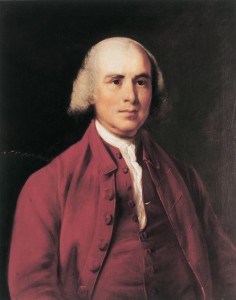 The Constitution was undeniably the idea, design, and proposal of James Madison, but so also was the Bill of Rights. The first 10 Amendments to the Constitution. Once the Constitution was ratified and signed by the 55 Representatives of the States in Congress, it had to be approved by each of the States individually.
 Today my wife and I ate at a restaurant named “Tender Greens” in San Diego, California. We are on a little trip together with our daughter and her husband. As we ordered our food at this nice eatery, I was reminded of Thomas Jefferson. I know, many things remind me of Jefferson.
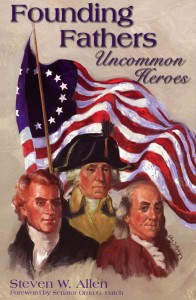 The Founding Fathers were patriots. The root word of ‘founding’ is ‘found’, which means to “take the first steps in building”. The first builders of the nation. The use of the word ‘father’ in this sense means originator. They began the whole thing.
 On one occasion I was speaking to about 300 people at a convention in Provo, Utah. My topic was “The Pursuit of Happiness—Thomas Jefferson.” I had 55 minutes to tell about Thomas Jefferson’s life and accomplishments. Needless to say, I only got to the highlights.
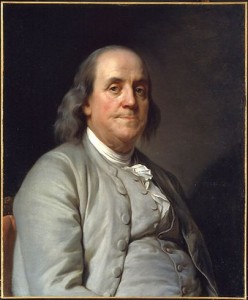 Yesterday I described on this blog Franklin’s Project for Moral Perfection. He had at first only 12 character traits he wanted to perfect. Then what happened is pretty comical as he describes it:
 In his autobiography Benjamin Franklin discusses his own “Project for Moral Perfection.” He decided he wanted to be as close to perfect as he could become in his life. He organized his project and listed 13 character traits he wanted to improve in relation to. These are all described in his book, as well as his definition of each and his chart that he worked on all his life.