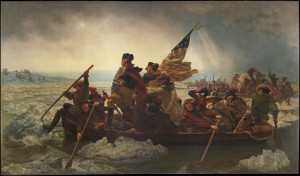
 Can you imagine if James Monroe, the lieutenant in charge of the cannon with General George Washington’s troops that crossed the Delaware River in December 1776, hadn’t been rescued by a medic when he suffered life-threatening wounds in the Battle of Trenton? If he hadn’t survived to become the fifth President of the United States of America we wouldn’t have the Monroe Doctrine.
But there was a medic there, and he was well suited to come to the rescue of James Monroe. Monroe survived the wounds and went on to make history.
 When things were getting rough in the Colonies, there were a few men who stood up for things they believed in. It started with Patrick Henry in his speech as he was first elected to the house of Burgesses. Thomas Jefferson, his friend, listened in at the door of the Capitol in Williamsburg, as Henry made his speech, from notes written in the flyleaf of Jefferson’s loaned book!
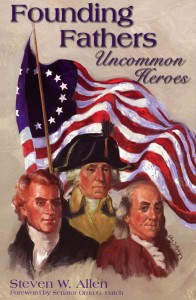 For years I have presented classes, speeches, and presentations about the Founding Fathers of our United States of America. I love to do it. I suppose during one of my speeches, I had become a little too enthusiastic and bombastic. One attendee came up to me afterwards to tell me as much!
 General George Washington, leader of the Revolutionary War, was worried about his troops during the Winter of 1777-78, as they were camped for the winter at Valley Forge. He turned to prayer.
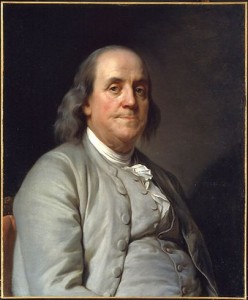 Benjamin Franklin wrote the book “The Art of Virtue” to help others understand that being true to oneself is being virtuous. Of course he also wrote this Autobiography, “Poor Richard’s Almanac”, and his book about Electricity. Several times he describes his “project for moral perfection, which he worked on all his life to improve his own character.
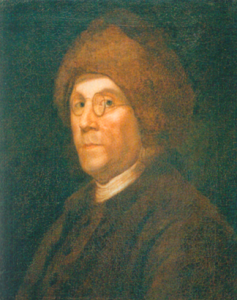 Besides being a successful printer, Benjamin Franklin was an inventor. He would often ask himself questions, such as how can I read my work and stay busy with other things. He needed to see things up close and at a distance.
 In 1863 there lived a young, penniless widow in New Hampshire named Sarah Hale. She established a popular magazine called “Godey’s Lady Book.” In her “book” she wrote some columns, some articles, some editorials, and even some recipes. (Reminds you a little of Benjamin Franklin and his “Poor Richard’s Almanac” doesn’t it?)