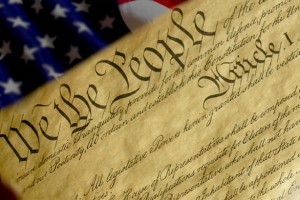
Citizens Amend the Constitution

constitutionThere is something I just can’t understand—at all! Yesterday in my blog I gave some little bit of background about our U.S. Constitution. I mentioned that our Constitution has been amended only 17 times since the original Bill of Rights was adopted. Seventeen times since December 15, 1791. That’s more than 225 years.

But two of those amendments came in 1913. What happened in 1913 that allowed those two amendments to be approved? Woodrow Wilson was president and started the “progressive” movement. Which shortly died out for a while, but it’s back now—with a vengeance. Just look, we have our first openly socialist candidate. read more

The U. S. Constitution and Its Amendments

constitutionThere has been much talk in the recent political arena about protecting the Constitution. There hasn’t been much talk about the Constitution itself and what it says or means. I sometimes wonder how much politicians, Senators, Representatives, Judges and even citizens really know about the Constitution. But it does make for a good sound bite.

When I think about the Constitutional Convention in Philadelphia in 1987, I am amazed that it even got ratified. There was much debate and disagreement. The room at Independence Hall was locked and the windows closed so the people wouldn’t see the contention in the debates. (Think of the televised debates today!) read more

Benjamin Franklin an Inspired Manager

Ben Franklin thumb pictureYou hear a lot of good things about Founding Father Benjamin Franklin. But usually you don’t equate him with being a good manager. Just look at his success with the printing business from which he retired in his fifties.

He was such a great manager that he not only succeeded and retired early, he helped others get started in the business. He told his followers to seek inspiration ahead of imitation. It worked for him!

Here’s what he said in his autobiography:

“Having emerg’d from the Poverty & Obscurity in which I was born and bred, to a state of Affluence & some degree of Reputation in the World (what an understatement—he was more well known that even George Washington throughout the world!), and having gone so far thro’ Life with a considerable Share of Felicity, the conducting Means I made use of, which, with the blessing of God, so well succeeded, my posterity may like to know, as they may find some of them suitable to their own Situations, & therefore fit to be imitated.” read more

Republicanism and The Trial of Christ

constitutionI know it’s a little bit early yet, but Easter is fast approaching. I have sometimes been asked why I have written my books on totally different subjects. Well, the short answer is my background is in law, therefore the Trial of Jesus Christ became a very real matter of interest to me.

I lived outside of the country for a while which imbued in me a spirit of patriotism. Then when I attended a conference in Philadelphia, in 1976, the Bicentennial of the Declaration of Independence my interest in the Founding Fathers grew by leaps and bounds. I gave many presentations about my heroes, George Washington, Benjamin Franklin, Thomas Jefferson, Patrick Henry, John Adams, and James Madison, to the point where people in my audiences began to ask for me to write a book. So I did. read more

John Adams and the U. S. Constitution

JohnAdamsJohn Adams doesn’t get the honor and acclaim he deserves! Even in his lifetime he saw this coming. He said:
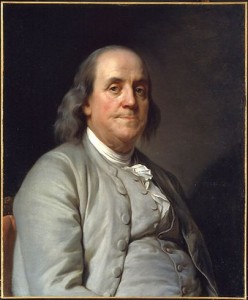
“The History of our Revolution will be one continued Lye from one end to the other. . . . The essence of the whole will be that Dr. Franklin’s electrical Rod, smote the Earth and out sprung General Washington. . . .That Franklin electrified him with his rod—and thence forward these two conducted all the Policy, Negotiations, Legislatures and War . . . . Mausoleums, Statues, Monuments will never be erected for me, . . . .nor flattering orations spoken to transmit me to Posterity in brilliant Colours.” read more

Benjamin Franklin and His Legacy

Ben FranklinOne of the most important, but often overlooked, details of Benjamin Franklin’s legacy, is that he was a doer, but a self-made man. Read his Autobiography if you haven’t already—or read it again for new insights.

He seemed to establish a link between effort and reward in the American cultural experience. His “rags to riches” is recorded in his own words for all American generations to read. It is a wonderful story. Ben started with little but gained much through his persistence and hard work. He demonstrated that effort is in time rewarded in the American Experiene. read more

Examples and Character

Ben Franklin thumb pictureA few posts back, I quoted a statement by Thomas Carlyle. Perhaps you’ll remember that he was a Scottish philosopher, writer, essayist, historian, and teacher. Here’s another quote from Carlyle that I think you’ll like:

“Show me the man you honor, and I will show you the kind of man you are, for it shows me what your ideal of manhood is, and what kind of man you long to be.”

Now that’s a very nice statement, but I don’t think I can actually live up to it! Because the men I honor are the Founding Fathers of our nation, George Washington, Thomas Jefferson, John Adams, Patrick Henry, James Madison, and Benjamin Franklin. They are my ideals, but I can’t live up to their example. read more

“And to the Republic . . .”

Ben FranklinThe Founding Fathers must have believed a democracy was the way to go, if what they gave us with the United States of America is really a democracy. No on both counts.

We actually live in a Republic. You know: “and to the Republic for which it stands.” Those great minds who gave us the Constitution disagreed on a lot of things, but they stood united on one thing—a democracy was the worst possible form of government.

Even the idea that our nation is built on “majority rules” is not near the truth. Yes, the Founding Fathers knew that a government if it became a democracy would soon lead to mob rule. And they expressed themselves that way. read more

Founding Fathers of the Past, Looking to the Future

Header5.jpgYes, I usually find a story about one of the Founders of our Nation to report about in our blog. But today I found a quote that I believe George Washington, because of his “Rules of Civility,” and Benjamin Franklin, because of his “Plan for Moral Perfection,” and even Thomas Jefferson, because of his love of literature, would adopt and accept as worthy of acceptation.

It’s from Ralph Waldo Emerson, and it has to do with finishing well. He wrote: “Finish every day and be done with it. You have done what you could. Some blunders and absurdities no doubt crept in: forget them as soon as you can. Tomorrow is a new day; begin it well and serenely and with too high a spirit to be cumbered with your old nonsense. This day is all that is good and fair. It is too dear, with its hopes and invitations, to waste a moment on yesterdays. What lies behind us are tiny matters compared to what lies within us.” read more

Founding Fathers and Leadership

Speaking-2My wife has been asking me what I want to do now that I’m retired. The other night I woke up at about 2 or 2:30 with a thought on my mind. It seemed important to me at that time in my groggy condition. So what did I do? I got out of bed, went into my office, found a scrap of paper and a pencil and wrote down my thought.

Then, the next day, I couldn’t find the paper on which I had written my thought. Yes, in between I guess I had cleaned off my desk. But that night, I had that same thought again. This time I wrote in down on the white board in my study. That would get misplaced! read more