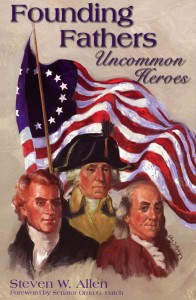
Founding Fathers—Uncommon Heroes

Founding Fathers coverThe Founding Fathers were patriots. The root word of ‘founding’ is ‘found’, which means to “take the first steps in building”. The first builders of the nation. The use of the word ‘father’ in this sense means originator. They began the whole thing.

In this context, a father is one who has become one of the leading men as of a country. Just like a man is a father to a boy. The originator, the starter, the one who sees it through.

The way we use these words together today refers to the men who were there at the beginning of our new nation. The ones who originated or started the process of building a new nation. Nation means a politically organized community. read more

Thomas Jefferson and the Mormon Tabernacle Choir

800px-Mtchoirandorchestra_ConferenceCenter_(cropped)On one occasion I was speaking to about 300 people at a convention in Provo, Utah. My topic was “The Pursuit of Happiness—Thomas Jefferson.” I had 55 minutes to tell about Thomas Jefferson’s life and accomplishments. Needless to say, I only got to the highlights.
Afterwards a very kind lady came up to visit with me for a minute and thank me for my address. She introduced herself as a member of the Mormon Tabernacle Choir. She went on to tell me about a choir tour that she was a part of. The Choir toured, visited and sang at some important places involved in U.S. History. read more

Humility for Benjamin Franklin!

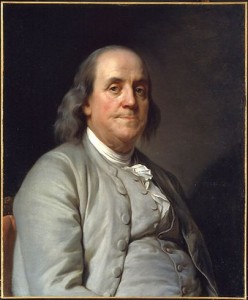
Ben FranklinYesterday I described on this blog Franklin’s Project for Moral Perfection. He had at first only 12 character traits he wanted to perfect. Then what happened is pretty comical as he describes it:

“My list of virtues contain’d at first but twelve; but a Quaker friend having kindly informed me that I was generally thought proud; that my pride show’d itself frequently in conversation; that I was not content with being in the right when discussing any point, but was overbearing, and rather insolent, of which he convinc’d me by mentioning several instances, I determined endeavoring to cure myself, if I could, of this vice or folly among the rest, and I added Humility to my list.” read more

Benjamin Franklin’s Project for Moral Perfection

Ben Franklin thumb pictureIn his autobiography Benjamin Franklin discusses his own “Project for Moral Perfection.” He decided he wanted to be as close to perfect as he could become in his life. He organized his project and listed 13 character traits he wanted to improve in relation to. These are all described in his book, as well as his definition of each and his chart that he worked on all his life.

I’ll just list these characteristics here:
1. Temperance—eat not to dullness. Drink not to elevation.
2. Silence—speak not but what may benefit others or yourself; avoid trifling conversation. Seek not to dispute or contend.
3. Order—Let all your things have their places; let each part of your business have its time.
4. Resolution—Resolve to perform what you ought; perform without fail what you resolve.
5. Frugality—Make no expense but to do good to others or yourself; that is waste nothing.
6. Industry—Lose not time; be always employed in something useful; cut off all unnecessary actions.
7. Sincerity—Use no hurtful deceit; think innocently and justly; and if you speak, speak accordingly.
8. Justice—Wong none by doing injuries, or omitting the benefits that are your duty.
9. Moderation—Avoid extremes; forbear resenting injuries so much as you think they deserve.
10. Cleanliness—Tolerate no uncleanliness in body, clothes, or habitation.
11. Tranquility—Be not disturbed at trifles, or at accidents common or unavoidable.
12. Chastity—Rarely use venery but for health or offspring, never to dullness, weakness or the injury of your own or another’s peace or reputation.
13. Humility—Imitate Jesus and Socrates. read more

George Washington According to Franklin

Ben FranklinThe story is told about a gathering of foreign ministers together for business and dinner a few years after the Revolutionary War. The British Ambassador presented his toast: “England—the sun, whose bright beams enlighten and fructify the remotest corners of the earth.”

Then the ambassador from France arose and gave his own toast: “France—the moon, whose mild, steady and cheering rays are the delight of all nations, controlling them in the darkness, and making their dreariness beautiful.” read more

Our Two Honest Presidents

GeorgeWashington“Oh, he’s a politician, you can’t believe anything he says!”
That’s what I heard the other day standing near a couple talking about the upcoming elections. It made me stop and think. Is that really what it has come to?

The story about George Washington and the cherry tree used to be taught in schools to help youngsters learn about honesty. Now it’s often pooh-poohed as a made up tale. The bloom is off the cherry tree—or at least it’s story.

Parson Weems, a regular at George Washington’s dinner table, wrote the story after George had passed away. It may be based
in fact. Parson may have heard it from George himself. (I’m not going to tell the story here, so for more on that tale, go to Founding Fathers—Uncommon Heroes, pages 39-41, if you’d like to read more about it). read more

Franklin and Moral Virtues

Ben Franklin thumb pictureWill Durant was an historian and philosopher. He wrote the major treatise “The Rise and Fall of the Roman Empire.” The he distilled more than 2,000 years of history into his favorite 3 little words. Those words? “Love one another.”

To this philosophy he added: “In all of western civilization, the person who stands out above all others is Christ.” Durant went on to say: “Christ was undoubtedly one of the most permanent influences on our thoughts, but on our actions (an important modification) Our actions,“ he continued, are very seldom Christian, but our theology often is.” read more

Ben Franklin the Inventor

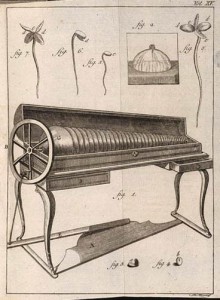
Benjamin_Franklin's_glass_harmonica_(LoC)_editedHe proved that lightning was made up of electricity. He designed the medical device called a urinary catheter, to save his brother. He invented the Franklin Stove and the lightning rod. He got tired of changing his glasses, so he invented the first bifocal lenses. He designed the odometer to figure out how far his carriage had traveled. He loved music and invented the Armonica. And on and on. He was the first great American scientist and inventor. (And you can add to that diplomat, statesman, and Founding Father.) read more

Easter, Virtue and Ben Franklin

Well, here it is –Easter Sunday, and I’ve still got a few good quotes for you from someone you’ve never heard of. But for Easter that’s OK!

Angels, roll the rock away;
Death yield up thy mighty prey;
See, He rises from the tonb,
Glaring with immortal bloom.
Al-le-lu-ia! Al-le-lu-ia!
Christ the Lord is risen today!
–Thomas Scott

Ben Franklin“Today one grave is open, and from it has risen a sun that will never be obscured, that will never set, a sun that creates new life, This new sun is the crucified one, the Son of God.” –Jean Marie Vianney read more

More Easter Messages, Including Benjamin Franklin

Ben Franklin thumb pictureI haven’t been to the bookstore to pick up new quote book yet. As I told you yesterday, the quote books I have did not have any quotes about Good Friday. Only one had some quotes about Easter, and those quotes are from people you won’t quickly recognize.

But here are a few more of the Easter quotes:

“The story of Easter is the story of God’s wonderful window of divine surprise.” –Carl Knudsen

“The great day does not merely arrive like a date on the calendar; it explodes!”

It used to anyway. I read in a paper this morning that less than half of those who proclaim to be Christian, in their survey, knew or believed that Easter recognizes the Resurrection of Jesus Christ. Less than half! And this used to be a Christian nation. read more