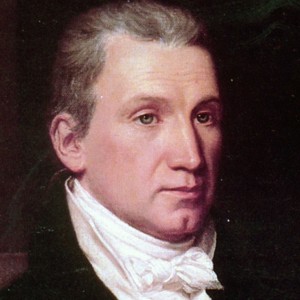
 James Monroe, while not considered one of the Founding Fathers directly, did serve with and was influenced by them. Monroe was in the camp with George Washington in December, 1776. You recall that was the month that Washington directed the assault across the Delaware River in a snowstorm to attack the British and their hired warriors, the Hessians. The Hessian were considered the most mighty and brutal of all the fighting armies at the time.
Washington’s men were exhausted and discouraged after making that dreadful voyage across the river and then marching to Trenton. Bloody footprints marked the passage of the Revolutionary army. They attacked the town in the early morning. And the American troops won a great victory that day.
History doesn’t often speak of it, but a young lieutenant by the name of James Monroe was in that army. Monroe courageously led the charge toward the Hessian army’s barracks. Monroe was wounded in the battle, and fell with his serious injuries. He likely would have died from his wounds, but miraculously a doctor was close by. Through the doctor’s actions and medical assistance Monroe recovered.
Indeed he survived to become the fifth President of the United States of America. Monroe had dropped out of the College of William and Mary to become a soldier in the Revolutionary War. His honesty and integrity were considered by all who knew him, to be beyond reproach. Thomas Jefferson said of him: “He is a man whose soul might be turned wrong side outwards without discovering a blemish.”
How does one go about gaining such a name for himself? Will Rogers put it this way: “Live in such a way that you would not be ashamed to sell your parrot to the town gossip.” Shakespeare said it a little differently: “To thine own self be true. Thou cans’t not then be false to any man.”
-

By: Steven W. Allen, J.D.
Steven W. Allen, J.D. is an author, speaker, and retired attorney. His book “Founding Fathers – Uncommon Heroes” is popular with all ages and is used in many schools. See his other books at www.StevenAllenBooks.com
-


-
The Federalist Papers
Constitutional Amendments
Founding Fathers and American Heroes
Founding Fathers and War
What About Benedict Arnold?
Books and Founding Fathers