The Tact of the Founding Fathers

“So be sure when you step,
step with care and great TACT.
And remember that life’s
A great balancing act.

And will you succeed?
Yes! You will indeed!
–Dr. Seuss

Abraham_Lincoln_2“Tact is the ability to see others as they see themselves.”
–Abraham Lincoln

“So you’ve got a problem? That’s good. Why? Because repeated victories over your problems are the rungs on your ladder to success With each victory you grow in wisdom, stature, and experience. You become a bigger, better, more successful person each time you meet a problem and tackle and conquer it with a positive mental attitude.”
–W. Clement Stone read more

George Washington Didn’t Quit

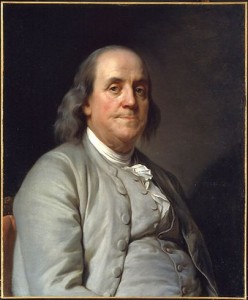
GeorgeWashingtonOne thing that the British are certain about is that General George Washington never quit. No matter how difficult the challenge, or how bad the weather, or how small the number of recruits, George carried on. He was after all the unanimously appointed Commander in Chief of the United Colonial Army.
He carried on courageously until Yorktown when he became the ultimate winner. What a war. But he still wasn’t finished.

I just read a story about another person who would quit. For some reason it made me think of all Washington had to endure. read more

Franklin as Postmaster—Again!

Ben FranklinBenjamin Franklin returned from a long, long business trip to London in 1775. He was happy to be home. But not quite as happy as those leaders of the Colonies.

John Hancock, of Boston, was President of the Continental Congress when Ben returned to Philadelphia. Ben was welcomed by his wife, by his friends in Philly, and by Congress, the Continental Congress, where he would become a delegate from Pennsylvania.

But before that John Hancock approached Benjamin Franklin with the news. “Dr. Franklin, we’re giving you your old job back as Postmaster of the Colonies.” read more

Benjamin Franklin and Religion

Ben Franklin thumb pictureBenjamin Franklin responded to his sister Jane Mecom of Boston in a letter in 1743. Jane was apparently concerned about Ben’s slightly unorthodox view and convictions.
Ben carefully explained his beliefs and stated gently: “There are some things in your New England doctrines and worship, which I do not agree with, but I do not therefore condemn them, or desire to shake your belief or practice of them.”

At the age of 37, Ben was a little ahead of his time relating to religious toleration soon to be called Freedom of Religion, because under the U.S. Constitution, First Amendment, we are guaranteed that no Government Religion would be established (Amendment I, December 15, 1791). read more

Benjamin Franklin’s Humility

Ben FranklinIn Benjamin Franklin’s Project for Moral Perfection he listed 13 characteristics that he wanted to improve during his lifetime. Yes, he wanted to become perfect. He had trouble with one of them and said:

“My list of virtues contain’d at first but twelve, but a Quaker friend having kindly informed me that I was generally thought Proud; that my pride show’d itself frequently in conversation; that I was not content with being in the right when discussing any point, but was overbearing, and rather insolent, of which he convinc’e me by mentioning several instances; I determined endeavoring to cure myself, if I could, of this vice or folly among the rest and I added humility to the rest.” read more

Connecticut Yankees

OLYMPUS DIGITAL CAMERAToday the citizens of Connecticut will vote in their primary elections. Did you know that the State anthem of Connecticut is “Yankee Doodle”? I didn’t.

That is a very interesting song with a fascinating history. It was sung by the British during the French and Indian War to signify that the colonists weren’t very good soldiers. Not disciplined, not brave, not very smart.

Yankee Doodle went to town
A ridin on a pony.
Stuck a feather in his cap and called it macaroni. Etc. Etc.

It was later sung by the British in the Revolutionary War to indicate their disdain for the rebels. Then it was adopted by some of the Revolutionary Soldiers, to throw it back in the face of the Redcoats. read more

George Washington and Walking Sticks

Landsdowne paintingIn the 1700’s walking sticks were all the rage in England. Everyone wanted one it seemed. The government, of course became quite worried. So there was a law passed that in order to stroll with the aid of a cane one had to purchase a license and abide by a strict set of rules.

It seemed that one of the rules prohibited the person with the stick from gesturing with or waving the stick in the air. He also could not hang the cane from his waistcoat, nor tuck it under his arm.

Gentlemen, being the gentle men that they were, seldom disregarded any of these rules. Thus there was never a cane mutiny. read more

Ben Franklin, Rainy Days and Libraries

Ben Franklin thumb picture

Benjamin Franklin credited libraries with turning common tradesmen into smart citizens. Especially on rainy days. Ben said it this way: “our people having no publik amusements to divert their attention to study, became better acquainted with books.” They didn’t have anything else to do on days with bad weather, rainy days.

Franklin began the first circulation public library in 1731 in Philadelphia, actually in all of North America. It soon caught on. Similar libraries were formed by other do good citizens in all the colonies. read more

Service Club with Benjamin Franklin

Ben FranklinHey, how would you like to have been in a service club with our Founding Father, Benjamin Franklin? Wouldn’t that have been great? He was a learned man, and you could learn much from him and his experience.

Benjamin Franklin founded “the Leather Apron Club,” more formally known as the Junto, in 1727, in Philadelphia. This was a forerunner of today’s types of service clubs such as Rotary, Kiwanis, Lions, and Optimists clubs. It was intended to provide a place where friends could come to learn from each other and help others as well. read more

Doctor Franklin

Ben Franklin thumb pictureI can remember being told sometime shortly after my receipt of my diploma for the grade of Juris Doctor (Doctor of Laws), that doctors were originally mostly lawyers! Well, we’re not to be confused with doctors of medicine. But the original doctor degrees were first issued to lawyers, doctors, and, of all things, religious leaders.

Nevertheless, Benjamin Franklin was often referred to as Doctor Franklin. I didn’t wonder about that too much until I started studying Dr. Franklin’s life. I learned that Benjamin Franklin received an honorary master’s degree from the College of William and Mary in 1756. He also received honorary DOCTOR degrees from across the Atlantic, the University of St. Andrews in 1759, the University of Oxford in 1762. And he also received doctorates from America’s oldest universities, Yale and Harvard. And then again from the College of William and Mary. read more