
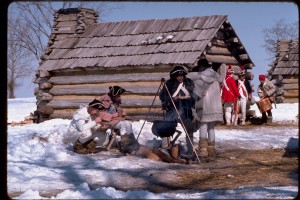
 George Washington and his soldiers, such as they were, established camp at Valley Forge, Pennsylvania. It was a week prior to Christmas. They stayed there until June, 1778. During those six months as many as 2,000 men died. It was cold during the winter months, but the men didn’t die due to the weather.
The close and unsanitary conditions at the camp became a breeding ground for dysentery, typhus pneumonia, and typhoid. But the main killer was not the disease either. The main problem was the surrounding farmers. Many of them chose to sell their produce to the British instead of the Army for the new United States. It seems they trusted the English sterling more than any recently minted American money.
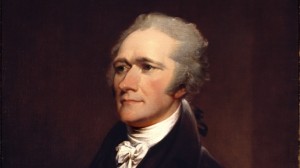 A good example is Alexander Hamilton. He was born in Nevis, the West Indies, to an unmarried mother. Somehow he found his way to America. He was introduced to George Washington who made him a part of his Revolutionary Army. He served so faithfully that Washington eventually named him to be his Secretary. He was valiant in the War and later served as George Washington’s Secretary of the Treasury.
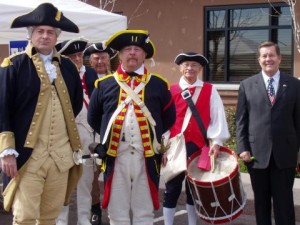 Numerous strange stories come out of the Revolutionary War. For one thing, the practice of hanging criminals and spies was often the case in that war. We know about Nathan Hale, who regretted that he had only one life to give for his country. Hanging was popularized in the Old West.
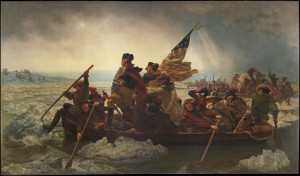 In the Revolutionary War the battles generally stopped in the winter months. That was mostly because of the cold and wet weather. George Washington didn’t consider that in his quest to cross the Delaware River and attack the British forces with the Hessian soldiers who were camped at Trenton, New Jersey. The main British army had stopped for rest, dining and dancing somewhat earlier.
 It doesn’t get much notice these days, but John Adams actually had quite a bit to do with our country becoming independent. One very interesting letter was written by Adams in support of William Hooper’s (William Hooper, who’s he?) preparation of a new written constitution for the State of North Carolina. This letter was later published by a Philadelphia printer. Here’s one sample paragraph:
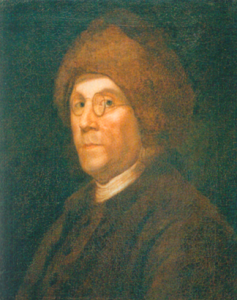 Benjamin Franklin and John Adams were commissioned to travel to New York to meet with the British at the request of Lord William Howe, a British General. As the two traveled to the scheduled meeting to try to resolve the problems that had caused the Revolutionary War, they had to spend a night at an Inn.
 After reviewing some things I have in common with John Adams, I had to remember why I started studying the Founding Fathers anyway. As a young lawyer I was appointed by the mayor of Phoenix, Arizona, to be a member of his “Citizens Crime Commission,” a group of volunteers who met monthly and discussed methods the Mayor could use to alleviate crime in the City.
 He had some interesting help along the way. Alexander Hamilton, James Monroe, General von Steuben, Nathan Hale, and even Thomas Paine. Paine was there when Washington crossed the Delaware for that famous battle of Trenton (and Princeton).
 The parents of Benjamin Franklin don’t receive much fanfare, notoriety, or acclaim about the lives they lived. Ben talks a little about them in his Autobiography. One of the things they taught Ben was to obey the commandments of God. As a result, he did honor them. After all, Honor thy Father and Mother is the first commandment with a promise—that your life may be long in the land.