Ben Tells Stories While Jefferson Cringes

ThomasJeffersonAfter Thomas Jefferson completed his draft of the Declaration of Independence, he submitted it to the committee ordained for that purpose. They made only a few changes or suggestions. Then it was placed before the whole Congress for its adoption.

Thomas squirmed as members of Congress made their own remarks and suggestions. John Adams defended it. Benjamin Franklin turned to Thomas Jefferson and told this tale from his days as a printer:

“One of my friends, an apprentice hatter, had decided to open a shop for himself. His first concern was to have a handsome signboard with a proper inscription. He composed it in these words: ‘John Thompson, hatter, makes and sells hats for ready money,’ with a figure of a hat subjoined.’ But he thought he would submit it to his friends for their amendments. read more

Independence Declared

On July 2, 1776, the proposition put forward by Richard Henry Lee, of Virginia, that these colonies have a right to be free and independent of Great Britain, was adopted by Congress.

JohnAdamsJohn Adams who had spoken fervently in Congress that such a proposition should definitely be approved, was excited. He was so proud of this accomplishment that on July 3, he wrote home to Abigail:
“Yesterday the greatest Question was decided which ever was debated in America, and a greater perhaps never was nor will be decided among men . . . The Second Day of July, 1776, will be the most memorable Epocha [sic}, in the History of America—I am apt to believe that it will be celebrated, by succeeding Generations, as the great anniversary Festival. It ought to be commemorated, as the day of Deliverance by Solemn Acts of Devotion to God Almighty. It ought to be solemnized with Pomp and Parade, with Shews [sic], Games, Sports, Guns, Bells, Bonfires, and Illuminations from one end of the Continent to the other from this Time forward forever more.” (Capitalization as in the original letter). read more

Independence Day Question

JohnAdamsOn this our 4th of July, or our Independence Day weekend, I am sorely reminded of the quote of Abigail Adams. As you know, she was the wife of John Adams, who argued on behalf of accepting Thomas Jefferson’s draft of the Declaration of Independence. As a result he was nicknamed “the Colossus” by Jefferson.

Abigail Adams uttered the agonizing question: “I wonder if future generations will ever know what we have suffered on their behalf?”

Patrick Henry, Thomas Jefferson, James Madison and the Constitution

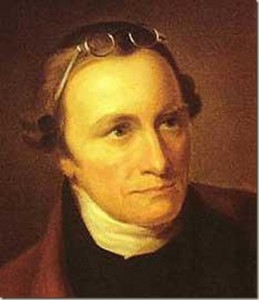
PatrickHenryThose Founding Fathers who were against the U.S. Constitution included Thomas Jefferson, and Patrick Henry. Both of them thought that the Constitution did not protect the average citizen enough.

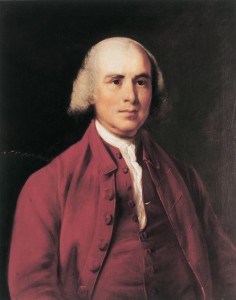
Jefferson was still in France, but sent his reservations by letter to his friend James Madison, the Father of the Constitution. He encouraged James to continued to fight for a Bill of Rights.

Patrick Henry opposed the Constitution in the Constitutional Assembly held in Virginia to vote on the document. He made several long speeches against its adoption, some lasting all day. He made at least one speech almost every one of the 17 days of the State Convention. He also wanted a more specific Bill of Rights. read more

George Washington, Benedict Arnold and George Will

GeorgeWashingtonIn all the political turmoil of late, the conservative editorial writer, George Will, has just declared that he will withdraw from the Republican Party. He says they have left him.

Where will Will go? I don’t know. The Democrats won’t take him. They say he’s too conservative. The Republicans don’t want him any longer. They say he’s a turncoat.

I’m sorry, but he reminds me a little of the story of Benedict Arnold. Arnold was a hero at the battle of Lake Champlain. He thought he should be advanced to the office of General. General George Washington agreed. But the Congress wouldn’t grant his request. read more

Abe Lincoln, Politicians, and Storytelling

To brag little, to lose well,
To crow gently if in luck,
To pay up, to own up,
To shut up if beaten,
Are the virtues of a sportingman.
–Oliver Wendell Holmes, 1841-1935, former Justice of the Supreme Court

Abraham_Lincoln_2Abraham Lincoln, of course, was a lawyer and a politician. I think he lived by the above instructions, if unknowingly. He was also a great storyteller.
He explained it this way: “They say I tell a great many stories; I reckon I do, but I have found in the course of a long experience that common people, take them as they run, are more easily informed through the medium of a broad illustration than in any other way, and as to what the hypercritical few may think, I don’t care!” read more

Thomas Jefferson’s Rare Declaration of Independence

ThomasJeffersonThe tale is told of Dave Randall, who was once the Customer Relations Expert for Scribner’s Rare Book Department. Randall had tried relentlessly to obtain one of an old collector’s thirteen copies of Thomas Jefferson’s Declaration of Independence. The owner stubbornly refused to let go of a single copy. He refused every overture attempted by Dave.

One Friday this owner called Dave Randall and said he had changed his mind. He was now ready to sell. It seemed to just come out of the blue. read more

John Adams and Benjamin Franklin in France

JohnAdamsAfter Benjamin Franklin was sent to France by Congress, John Adams was soon sent to join and assist him in his labors. Adams and Franklin were very different personalities. Ben was very patient, diplomatic, affable and even affectionate.

John Adams, on the other hand was terse, undiplomatic, impatient, and even gruff at times. Ben and John didn’t see eye to eye on how to proceed. Finally John became so impatient that he uncharacteristically left his assignment and travelled to Amsterdam where he was able to be introduced to some Dutch bankers. Men who controlled money. He was able to convince them to come to the aid of the Colonies, and save the Revolution at desperate time in the War. Thus saving the armies of Washington. read more

Happy Father’s Day!

GeorgeWashingtonI want to wish all you Fathers a Happy Father’s Day, 2016! Being a father myself, I know how good it makes you feel to be acknowledged as a good father.

But did you know that two of our nation’s Founding Fathers, were indeed Founding Fathers, but they had NO children of their own?

Yes, it’s true. George Washington, known as “The Father of our Country, did not have any children of his own. Martha had children when they were married. She was a widower. But George gave her no children.

JamesMadisonAnd James Madison, known as “The Father of the Constitution” also had no children of his own. He married Dolley Madison, who had children from a prior marriage, and who, like Martha Washington, was a widow when she married James Madison. He helped raise her children, but again they had no children together. read more

George Washington as a Leader

Landsdowne paintingWhen the U.S. Constitution was ratified and George Washington was elected as the first President of the United States of America, not only was a new nation created, but also a new culture.

This new nation was based on the founding principles of honesty, human rights, and virtue. The nation provided as John Adams described it: “a light on a hill” for all to look to admire, and duplicate. There was an excellence for other nations, and peoples, to strive after.

The creation of the United State of America gave other nations an understanding that the United States of America is a place where people could be free. They would be free to practice their religion as they chose, free to think whatever was on their minds, and even free to speak those thoughts. read more