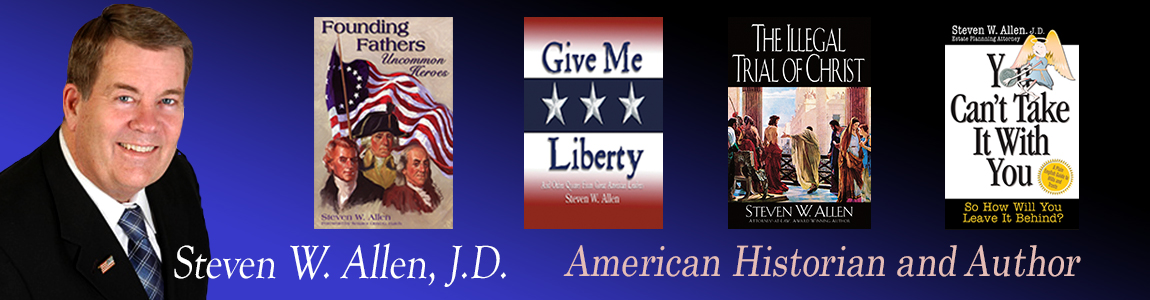
A Few Random Thoughts From the Founding Fathers

“Only a virtuous people are capable of freedom. As nations become corrupt and vicious, they have more need of masters.” -Benjamin Franklin   “I believe He (God) is pleased and delights in the Happiness of those he has created; and since without Virtue Man can have no Happiness in this world, I firmly believe he delights to see me Virtuous because He is pleased when he sees me Happy.” -Benjamin Franklin (capitalization as he wrote it.)  

“Of all the dispositions and  habits which lead to political prosperity, religion and morality are indispensible supports. . . . (R)eason and experience both forbid us to expect that national morality can prevail in exclusion of religious principle. -George Washington read more

WHO WOULD ARGUE WITH GEORGE WASHINGTON?

George Washington’s self made will had some wonderful features. I’m thinking of re-popularizing at least one of them. You see, he had a well constructed clause to direct the settlement of disputes in the event there should be any.

As an estate planning attorney, I have long been a proponent of using revocable living trusts in the process. They avoid probate, make the settlement go smoothly, and cost less money in the long run. And they generally avoid conflicts in settling an estate.

A living trust is a written document to perform the same functions as a Last Will and Testament. But it does so without probate, if properly written and funded. Thus keeping the estate out of Court. So in order to dispute the trust, a new lawsuit must be filed. This was often considered unworkable. read more

Liberty or Not — That is the Question

When any attention is paid to our nation’s founding documents, much attention is paid to the Preamble of the U.S. Constitution, especially to the phrase “promote the general Welfare.” It seems to me that too little attention is paid to the words immediately following that phrase.  The words “and secure the Blessings of Liberty to ourselves and our Posterity” perhaps currently need much more attention by the citizenry and its representatives.

Are we trying at all to secure the “Blessing of Liberty to ourselves and our Posterity” when we go on unbridled spending sprees? Are we selling our Liberty for a mess of pottage? Are we purchasing our security for a loss of our Liberty, our Liberty and that of our children? read more

A Vow is Only as Good as an Oath

Every public servant, such as a judge, Senator, or Congressman, makes a personal oath when entering into such a position. It is required by the Constitution.

The Presidential Oath is set forth in the Constitution as: “I do solemnly swear that I will faithfully execute the Office of President of the United States, and will to the best of my Ability, preserve, protect and defend the Constitution of the United States.”

When being sworn in as our first President, George Washington spontaneously added the words: “so help me God.”  This has becoome a traditional part of the Oath of office. read more

John Adams–What is Your Recipe for Preserving the Constitution?

John Adams was the First Vice President of the New United States of America, serving under the Father of Our Country, George Washington. When Washington refused to serve a third term as President, John Adams was elected President. He served only one term.

In his Inaugural Address John Adams shared his vision for America as a “City on a Hill,” to be admired by every Nation of the Earth as a beacon for liberty and freedom. Adams advocated the support of “every rational effort to encourage schools, colleges, universities, academies, and every institution for propagating knowledge, virtue, and religion among all people. [It is] the only means of preserving our Constitition.” read more

Were the Founding Fathers Christian?

Thinking about Easter today, I was contemplating on some of the pictures people have today about the Founding Fathers. Some people hold to the teachings they now receive in school that the Founding Fathers were not Christians. That they were either unbelievers, athiests, or Deists. Such people should read some of their own words. Words of the Founders of this Nation. Here are just a select few.

George Washington was a Christian, attending services as often as he could. He was a vestryman and a Church warden, and supported the Church with generous financial offerings. He often acknowledged the protection by hand of Providence in his life. He was often seen in prayer, especially at Valley Forge. He said: “I was in hopes (that the present age) would at least have reconciled Christians of every denomination (to add to) the peace of society.” read more

George Washington Had a Bad Cold!

On a trip last week to visit our daughter and to speak about Patrick Henry, I caught a bad cold. On the day I was to make my presentation about one of my favorite founding fathers, I began to lose my voice. I made it through my presentation okay, but my cold and cough got worse. It began to remind me about George Washington.

In December, 1799, George Washington rode out about his beautiful plantation at Valley Forge to mark some trees which needed to be chopped down or trimmed. He kept riding in the midst of snow and sleet. As George returned home, his neck was wet with melted snow and he began to be hoarse. read more

George Washington U.S. President – two terms

Did you know that George Washington was sworn in for his second term as the President of the United States of America on March 4, 1793?

Following the drafting of the new Constitution for the United States of America, it was sent out to the various States for ratification. In 1787 three States ratified it. In the next year, eight more States gave their approval. On April 6, 1789, the Constitution of the United States became the basic law of the land as the electoral college unanimously elected George Washington as its first President. read more

George Washington: What Happened to Your Birthday?

George Washington was born on February 11, 1732. Yes, that’s February 11. The British colonies (which is what the United States of America was then) still used the “old style” , or Justinian, calendar. They didn’t begin using the Gregorian (or new style) until 1752, when George would have been 20 years of age, and before we declared our Independence from Great Britain.

Then George’s birthday was changed to February 22, because of corrections in the dates of the new calendar. When our new President’s Day celebration began, the celebrations of George Washington’s and Abraham Lincoln’s birthday were combined to create this holiday. Now many have forgotten George Washington’s birthday all together. read more