Music and the Founding Fathers

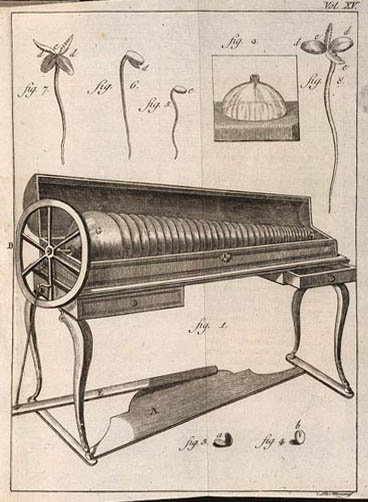
Benjamin_Franklin's_glass_harmonica_(LoC)_edited

Benjamin Franklin’s Glass Armonica

Did you know that Thomas Jefferson was also a musical devotee. That’s why he and Martha Wayles Skelton were so enamored with each other at first. Martha would play the harpsichord and Tom his violin. They loved to sing and dance. Tom ordered a beautiful harpsichord from his agent in Europe, and had it shipped to Virginia as a wedding gift for Martha. So among all the other talents Tom is credited with, music must be counted.

George Washington also loved to dance and loved music. That’s why he and Martha Custis originally hit it off so well together. George loved to have young people come to dances at his home at Mount Vernon. When George walked into the dance parlor, music and dancing would stop, and the youth would stare at George. So George, instead of entering the dance hall, would sometimes stand at the door and look through a crack between the doors to enjoy the dance. read more

George Washington Says Listen Up!

Scene_at_the_Signing_of_the_Constitution_of_the_United_States“Listen twice as much as you talk and others will hear twice as much of what you say.” Nido R. Qubein. Nido should know. He’s the President of High Point University, and a professional speaker.

This quote reminds me so much of George Washington. George would listen carefully to his soldiers in the Revolutionary War—and you know how that turned out!

I think the best example of Washington’s listening skills took place at the Constitutional Convention in Philadelphia. George was elected President of that convention, even though originally he didn’t intend to attend. He listened to his friend James Madison, and decided he must be there. read more

The Constitution, American History and Economics

Just thought you’d like to know about how you can get a little more learnin’. You know, things about George Washington, James Madison, Patrick Henry, and important documents like the Declaration of Independence, the U.S. Constitution, the Bill of Rights, and much more.

Hillsdale College has more than 830,000 students enrolled in its free online courses, covering topics such as the Constitution, the principles of free-market economics, American history, the Western Heritage, and more. These courses are transformative—they can and will have a profound effect on the future of our country, especially at such a time as this. read more

Hebrew Law and U. S. Law

Illgegal Trial of Christ coverI’ve been re-reading a 2 volume work by Walter Chandler entitled “The Trial of Christ.” This book explains the Hebrew rules of court in great detail. It likewise explains the Roman laws, which were necessary because Judea was a nation conquered by Rome prior to the trial of Christ.

The amazing thing is it’s a wonder that anyone was ever found guilty of a crime punishable by death because the rules were so stringent about witnesses and judges (members of the Sanhedrin). But then as you read the accounts in the four Gospels of what transpired to bring Christ to the cross, you see vividly how many of the laws and rules of procedure were intentionally violated. read more

George Washington’s Church

I recently came across a copy of a newspaper called “Globe Leader,” dated January 13, 2013.  It’s a newspaper from New Wilmington, PA. In it there is an article about a Christ Church in Alexandria, VA, where George Washington had a family pew. It’s still there, and it’s the only pew left with a swinging door and a little metal plate with the name “George Washington family.”  Visitors are welcome to sit in it.  There is a list of George’s honorary pall bearers for his funeral, which must have been at this church. read more

And To Think It All Started With 10 Commandments

On the wall in my law office, next to my grand bookcase full of law books, I had a framed cartoon.  It wasn’t a very large cartoon, but it made a point. The cartoon drawing showed a man, presumably a lawyer, standing in front of an enormous bookcase, full of law books. The man’s image of a thought balloon held these words:  “And to think it all started with just 10 Commandments!”

On July 4, 1776, 56 representatives from the original 13 colonies in America chose to begin a new nation. They declared our independence from Great Britain with an inspired document. That was the beginning of the United States of America. read more

“I Cannot Live Without Books!”

It is interesting and even fascinating to me how much respect and reverence our Founding Fathers had for books. Of course books were then very expensive and dear. And there was no modern technology to compete: no computers, iPads, internet, telephones, cars, refrigerators, radio or television. Still, they knew how important books were to their education, knowledge, getting ahead, and even sometime their very existence.

With apologies to Nancy Sinatra, the Founders of this nation knew “these books were made for reading, and that’s just what you’ll do. One of these days these books will make a scholar out of you!” read more

Independence Day – How It Happened – Part 4

Thomas Jefferson explained that the object of the Declaration of Independence was:

“Not to find out new principles of new arguments never before thought of, not merely to say things which had never been said before; but to place before mankind the common sense of the subject, in terms so plain and firm as to command their assent, and to justify ourselves in the independent stand we [are] compelled to take.”

The Declaration was intended to be an expression of the American mind. Jefferson wrote of his completed project:  “Whether I had gathered my ideas from reading or reflection I do not know. I know only that I turned to neither book nor pamphlet while writing it.” read more

Indepence Day – How It Happened – Part 3

The draft of Jefferson’s declaration was submitted to the committee. Benjamin Franklin made a few suggestions and improvements agreed to by Jefferson. They were incorporated into the draft which was submitted to Congress on Friday, June 28, 1776.

It too, was tabled until a vote could be taken on Richard Henry Lee’s resolution to break with Great Britain. That resolution was adopted by Congress on July 2. John Adams thought that day would become the day of celebration. The next day he wrote to his wife, Abigail: read more

Independence Day – How It Happened – Part 2

The committee for the preparation of a draft of a declaration of independence was made up of Benjamin Franklin, Thomas Jefferson, John Adams, Roger Sherman and Robert Livingston. They met together to decide which of them would write the intial document for consideration. It was proposed that Benjamin Franklin, the oldest, wisest, most experienced of the team should be the scrivener. He declined, arguing that it wouldn’t be proper or smart for him to write the original document, as his son, William, had remained a loyalist, and was then the Governor of New Jersey. read more