Ben Franklin, Rainy Days and Libraries

Ben Franklin thumb picture

Benjamin Franklin credited libraries with turning common tradesmen into smart citizens. Especially on rainy days. Ben said it this way: “our people having no publik amusements to divert their attention to study, became better acquainted with books.” They didn’t have anything else to do on days with bad weather, rainy days.

Franklin began the first circulation public library in 1731 in Philadelphia, actually in all of North America. It soon caught on. Similar libraries were formed by other do good citizens in all the colonies. read more
Service Club with Benjamin Franklin

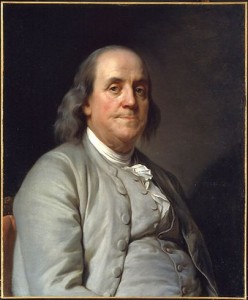
Ben FranklinHey, how would you like to have been in a service club with our Founding Father, Benjamin Franklin? Wouldn’t that have been great? He was a learned man, and you could learn much from him and his experience.

Benjamin Franklin founded “the Leather Apron Club,” more formally known as the Junto, in 1727, in Philadelphia. This was a forerunner of today’s types of service clubs such as Rotary, Kiwanis, Lions, and Optimists clubs. It was intended to provide a place where friends could come to learn from each other and help others as well. read more

Death and Taxes

Ben Franklin thumb pictureIn honor of this Tax Day in these United States, I leave only a quote from Benjamin Franklin:

“In this world nothing can be said to be certain, except death and taxes.”

Of course you’ve heard that one, but have you heard this quote from him? He was once asked if our country should ever have income or direct taxation. (You know that was unconstitutional until 1913 and the sixteenth Amendment).

“His response was immediate and direct: “No. An income tax will make liars out of the people and a despot out of the government.” read more

Thomas Jefferson’s Birthday!

ThomasJeffersonThomas Jefferson should truly be remembered and honored today. What did he accomplish? I’ll just mention a few here. He graduated from William and Mary College and then studied law for 5 years under George Wythe, the first law professor in Virginia.
By then he was already an accomplished violinist and dancer. He fell in love with and married another musician, Martha Wayles Skelton. He had already begun construction on Montecello, so they moved in to the one room that was finished there. He worked on building and remodeling for the next 40 years. (If you haven’t been there, you should go to visit and to observe the detail and the beauty of his mansion on the hill. read more

What? A Violent Benjamin Franklin?

Ben Franklin thumb pictureFranklin, of course, was first a printer. And a good one at that. Of course he needed things to print in his newspaper. He loved good stories. He even made some up—especially to discourage the British in the Revolutionary War.

Did he go too far? Only you can decide. In 1789, the year before Ben died, a newspaper article was printed in which Ben is reported to have said:

“My proposal, then, is to leave liberty of the press untouched, to be exercised in its full extent, force and vigor, but to permit liberty of the cudgel (which is a short and heavy club, for those of you who can’t remember your high school English) to go with it . . . .Thus, my fellow citizens, if an impudent writer attacks your reputation, dearer to you perhaps than your life, you may go to him openly and break his head.” (Clarence S. Brigham, Journals and Journeymen, Philadelphia: University of Pennsylvania Press, 1950, page 69. Emphasis omitted, spelling and capitalization modernized. read more

Benjamin Franklin’s Mistakes He Never Made

Ben FranklinBenjamin Franklin will be the first to admit that he made mistakes. Plenty of them. However, there appear to be at least 3 mistakes he never made. He tells us about those.

Franklin never accepted the current situation to be unchangeable. He thought he could change things for the better, and he looked for ways to do it. If something wasn’t quite right he would rack his mind, or work on whatever the conditions were until he could find a solution. A good example of this is when his brother suffered from kidney stones, he developed America’s first urinary catheter to ease the problem. read more

James Madison and the Bill of Rights

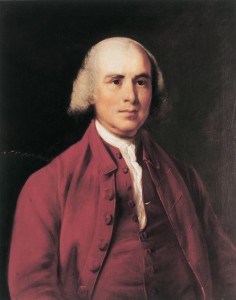
JamesMadisonThe Constitution was undeniably the idea, design, and proposal of James Madison, but so also was the Bill of Rights. The first 10 Amendments to the Constitution. Once the Constitution was ratified and signed by the 55 Representatives of the States in Congress, it had to be approved by each of the States individually.

In an effort to gain the votes of the States, Madison, together with John Jay and Alexander Hamilton wrote the “Federalist Papers” to fully explain the meaning and importance of the Constitution. Nine State had to adopt it before the Constitution would replace the Articles of Confederation as the principle document uniting the States. read more

Thomas Jefferson and the Mormon Tabernacle Choir

800px-Mtchoirandorchestra_ConferenceCenter_(cropped)On one occasion I was speaking to about 300 people at a convention in Provo, Utah. My topic was “The Pursuit of Happiness—Thomas Jefferson.” I had 55 minutes to tell about Thomas Jefferson’s life and accomplishments. Needless to say, I only got to the highlights.

Afterwards a very kind lady came up to visit with me for a minute and thank me for my address. She introduced herself as a member of the Mormon Tabernacle Choir. She went on to tell me about a choir tour that she was a part of. The Choir toured, visited and sang at some important places involved in U.S. History. read more

Our Two Honest Presidents

GeorgeWashington“Oh, he’s a politician, you can’t believe anything he says!”

That’s what I heard the other day standing near a couple talking about the upcoming elections. It made me stop and think. Is that really what it has come to?

The story about George Washington and the cherry tree used to be taught in schools to help youngsters learn about honesty. Now it’s often pooh-poohed as a made up tale. The bloom is off the cherry tree—or at least it’s story.

Parson Weems, a regular at George Washington’s dinner table, wrote the story after George had passed away. It may be based
in fact. Parson may have heard it from George himself. (I’m not going to tell the story here, so for more on that tale, go to Founding Fathers—Uncommon Heroes, pages 39-41, if you’d like to read more about it). read more

Franklin and Moral Virtues

Ben Franklin thumb pictureWill Durant was an historian and philosopher. He wrote the major treatise “The Rise and Fall of the Roman Empire.” The he distilled more than 2,000 years of history into his favorite 3 little words. Those words? “Love one another.”

To this philosophy he added: “In all of western civilization, the person who stands out above all others is Christ.” Durant went on to say: “Christ was undoubtedly one of the most permanent influences on our thoughts, but on our actions (an important modification) Our actions,“ he continued, are very seldom Christian, but our theology often is.” read more