John and John Quincy Adams

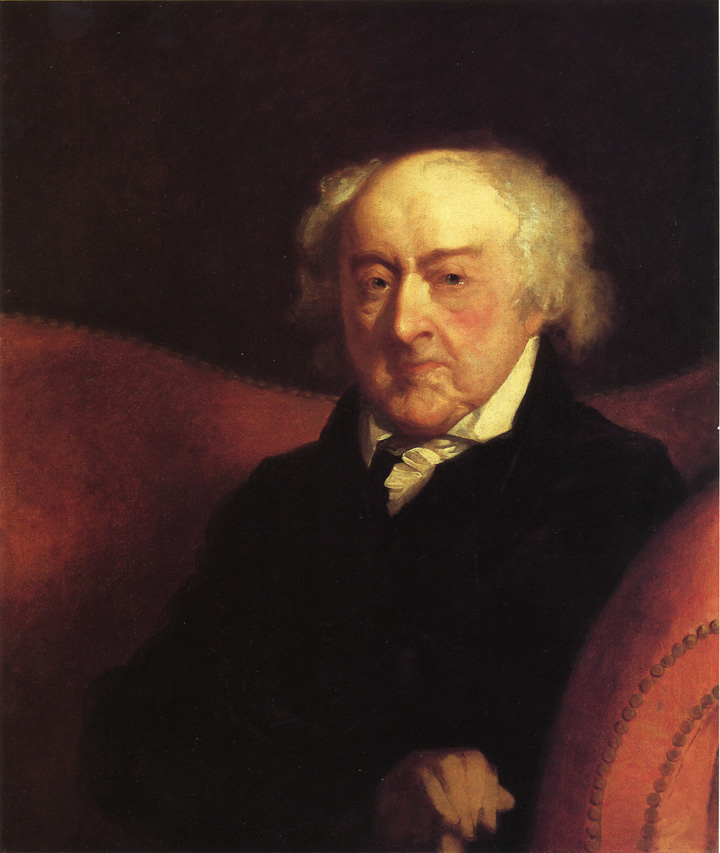
John_Quincy_Adams_by_George_Caleb_Bingham_(detail),_c._1850_after_1844_original_-_DSC03235One of the delights of John Adams’ old age was the satisfaction of having his son, John Quincy Adams, be sworn in as the 6th President of the United States of America. This took place in 1825, the year before the death of John Adams.

John’s son, John Quincy, won his election to the Presidency by only one vote when the evenly divided popular vote threw the election into the House of Representatives for a deciding vote.

The House was also evenly divided on the issue. When one final vote was taken, the Congressman from New York, in an answer to his prayer, picked up a crumpled ballot, and voted for the name on the ballot, esteeming it an answer to his prayer. The name on that crumpled up ballot was John Quincy Adams. read more

Jefferson’s War and the Barbary Pirates

ThomasJeffersonIn the early days of our Nation, John Adams at first didn’t want to build up our Navy after the Revolutionary War. When Thomas Jefferson was elected to replace Adams, the nations of Europe and the United States were becoming more and more subject to the pirates of the Barbary coast.

When merchants wanted to sail through the Mediterranean Sea they were charged a bounty by the Barbary Pirates in order to pass Tripoli and other ports without being attacked. The Barbary Pirates were actually Muslims trying to extort benefits for not destroying the ships together with their cargoes. Most nations went along with this blackmail. It was just easier than fighting. read more

More About C.S. Lewis

Illgegal Trial of Christ coverI hope you understand that I enjoyed reading “Mere Christianity” by C. S. Lewis. Pick it up for yourself. Not only will you learn something about Christianity, but also about yourself and progress. You will learn things about Christianity, but also about life and decisions you make. Let me give you one example:

“ . . . progress means getting nearer to the place where you want to be. And if you have taken a wrong turning, then to go forward does not get you any nearer. If you are on the wrong road, progress means doing an about-turn and walking back to the right road; and in that case the man who turns back soonest is the most progressive man. read more

Jefferson Speaking of Madison

ThomasJeffersonAs you know Thomas Jefferson and James Madison were great friends.

As Jefferson completed his mansion “Monticello”, he built into the second floor a room dedicated to visits from James and Dolley Madison.

Jefferson also sent Madison a trunk full of volumes of books from France, regarding government and history to help Madison in drafting the U.S. Constitution. Jefferson was serving as Minister to France at the time at the discretion of Congress.

The erudite Jefferson was excited and inspired by the learning and academic study of James Madison. Here’s what Thomas Jefferson said about his kindred spirit, James Madison: read more

Patrick Henry’s Claim to Fame

PatrickHenryMost people today don’t know very much about Patrick Henry. Through my study of the Founding Fathers, he has become one of my favorites. He had much to say to us and to do for us. Not the least off which was his example of good character.

Perhaps a fitting epitaph of this amazing man is the one paid to him by his grandson who described Henry as always setting “a good example of honesty, benevolence, hospitality and every social virtue. He assisted in the education of his . . . children and especially devoted much time to earnest efforts to establish true Christianity in our country.” read more

John Adams and Trust

JohnAdamsJohn Adams is possibly to most forgotten Founding Father and President we have had as a new nation. He did and said some amazing things. Here’s one of his thoughts:

“There is danger from all men. The only maxim of a free government ought to be to trust no man living with power to endanger the public liberty.”

I wonder what he would think of today’s situation in the world!”

Benjamin Franklin’s Airbaths

Ben FranklinFranklin had a habit of engaging in a daily “Air Bath.” When Ben would arise every morning, he would open every window in his room, remove all of his clothes and sit around in the room for an hour or so in the “altogether”. Not even cold winter weather would discourage him in this practice.

He often recommended this practice to his friends or fellow traveling companions. He once told John Adams that this was the reason he rarely suffered from a cold. John Adams, however, couldn’t quite convert to it! read more

Happy Halloween, Greet Thanksgiving

800px-Mtchoirandorchestra_ConferenceCenter_(cropped)They didn’t have Halloween celebrations or trick or treating in the early days of our nation. No masquerade balls, or trunk or treating either.

But they did begin to get ready for Thanksgiving. I hope that’s what we all will do now. It will be here quickly!

“The greatest saint in the world is not he who prays most or fasts most; it is not he who gives alms, or is most eminent for temperance, chastity, or justice. It is he who is most thankful to God, and who has a heart always ready to praise Him.” –William Law read more

The Founding Fathers and the World Series — NY Mets? KC Royals?

Polo Grounds during World Series Game, 1913 from the Bain Collection by David Shapinsky from Washington, D.C.

Polo Grounds during World Series Game, 1913 from the Bain Collection by David Shapinsky from Washington, D.C.

There’s still argument over the actual beginning of baseball in the United States, but the World series didn’t actually begin until the early 1900’s. So it’s clear that our Founding Fathers would not have been interested in the World Series, or even known of it.

But if we could consider it, who would the Founding Fathers root for in a game. In today’s world series, George Washington would, of course, root for the New York Mets, having served as President in New York — Washington, DC was still on the drawing board. Although he was a great horseman and didn’t have professional sports in those days, I think he would like the game of baseball. read more

Jefferson and Listening

ThomasJeffersonThomas Jefferson served with Patrick Henry and George Washington in the House of Burgesses. He served later in the Continental Congress with Benjamin Franklin. One thing Jefferson learned from these three men, and especially Franklin and Washington, was how to listen. George was especially adept at this trait.

Jefferson made it a point not to argue and to try to be a peacemaker. Of his experience in Congress he wrote in his autobiography:

“Our body was a little numerous, but very conscientious. Day after day was wasted on the most unimportant questions. A member, one of those afflicted with the morbid rage of debate, of an ardent mind, prompt imagination, and copious flow of words, who heard with impatience any logic which was not his own, sitting near me on some occasion of a trifling but wordy debate, asked me how I could sit in silence, hearing so much false reasoning, which a word would refute? I observed to him, that to refute indeed was easy, but to silence was impossible.” read more