About Steven W. Allen, J.D.

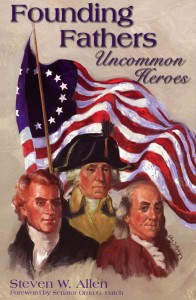
Steven W. Allen, J.D. is an author, speaker, and retired attorney. His book "Founding Fathers - Uncommon Heroes" is popular with all ages and is used in many schools. See his other books at www.StevenAllenBooks.com

Big Decisions

GeorgeWashington“Make big decisions in the calm.” That’s what Dwight D. Eisenhower said. As you know, he was the nation’s 34th President.

Dr. Seuss said it this way:
“Try to remember,
through thick and through thin,
when you give it your best,
why that’s when you win.”

Colonel Von Steuben said it this way to General Washington:
“To an American I am obliged to say, this is the reason why you ought to do that, and then he does it.”

Dorothea Brandt, a writer, put it this way:
“The key to success is to determine your goal and then act as if it were impossible to fail—and it shall be!” read more

Most Americans Love Benjamin Franklin

Founding Fathers cover

I know you really admire Ben Franklin and all he accomplished. But I bet you didn’t know that during his lifetime children also loved Franklin. And he just loved them right back. Occasionally he showed them his compliments for children and even their pets, by writing rhyming poetry. Simple rhyming verse.

Once Ben sent to the children of friends of his in England the gift of an American squirrel which he had named “Skug”. Skug is the Indian name for the gray squirrel.

A year later Ben received a note from the English children sharing with Ben Skug’s untimely demise. Ben wrote back to the children expressing his condolences and including an epitaph for the burial of Skug. Here is what he wrote: read more

Battle for Independence

Ben Franklin thumb pictureYou may have missed it but the Revolutionary War ended in 1781 at Yorktown, VA. The particulars of that battle were amazing. So was the outcome. British General Cornwallis surrendered his army after the valiant efforts of the Americans and the French.

After the defeat at Yorktown, a friend of Benjamin Franklin approached him and said: “It looks as if the battle for independence is finally over.”

Franklin replied: “Sir, you are mistaken. The Revolutionary War may be over, but the battle for independence has just begun.” read more

A Note From George Washington

Landsdowne paintingBenjamin Franklin was aware that he was dying in 1790. He was cared for by his daughter, Sara Franklin Bache. One evening a knock came at the door. A messenger carried a letter from President George Washington.
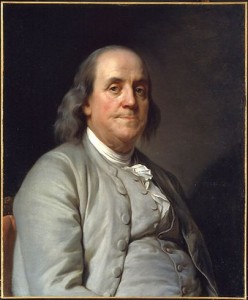
Sara answered the door and announced the arrival of the message. Benjamin Franklin, who was by now half blind, said: “Sally (as he called his daughter) please read me the missive.”

She opened the note and this is what she read:

“If to be venerated for benevolence, if to be admired for talents, if to be esteemed for patriotism, if to be beloved for philanthropy, can gratify the human mind, you have the pleasing consolation to know that you have not lived in vain.” read more

Friends and Influence by Franklin

Of course Dale Carnegie wrote the bestseller “How To Win Friends and Influence People.” That book is still popular and has some great tips and suggestions.

Benjamin Franklin once wrote a pamphlet that sounds like just the opposite. Kind of a “How to Win Foes and Offend People.” It was called: “Rules for Making Oneself a Disagreeable Companion.” This never gained the popularity of Poor Richard’s Almanac, but it did contain some clever language. Here’s a sample:

“1. If possible engross (occupy wholly) the whole discourse . . . .Talk of much of yourself, your knowledge, your education, your successes . . . .” read more

Franklin’s Autobiography

Ben Franklin thumb pictureIn high school one of the books that was required reading was Benjamin Franklin’s Autobiography. I don’t know if it still is. But I do know it had an effect on me, not a major one at the time, but still an effect. Which is saying something for a high schooler.

I’ve read it several times since. It is an amazing book. Did you know that even though Franklin was not the first to write an autobiography, he was the first to have one become what we would now call a Bestseller? It was highly successful commercially. In his day it was even translated into French, Spanish, German and English (that is there was a British equivalent). read more

Benjamin Franklin and Travel

Ben FranklinIn the 1750’s Ben Franklin was the Postmaster General of the Colonies. As you can imagine, travel was very different and difficult in those days. There were no Marriott Residence Inns or even a Motel 6! There were some local inns, which were not much more than saloons with an extra bed room or two. That meant a room with a bed in it, no showers or extras.
Reservations couldn’t be made by phone, or even telegraph, yet. Ben would just hope he could maybe find appropriate accommodations for his overnight stays. read more

George Washington and The Grand Old Flag

Founding Fathers coverBetsy Ross was a recent widow, and she was a poor, struggling seamstress when the story goes, she was approach by a team, including General George Washington to create a new flag for the hope of a new nation. It was apparently a secret meeting. General Washington asked her for help in the preparation of a brand new flag, and a new concept for a struggling nation.

Some historians doubt the story at least a little. Why? Because a man named Francis Hopkinson asked to be credited and paid for the production of the new flag. Who was Hopkinson? He was an author and a delegate to the Continental Congress from New Jersey. He asked to be paid for ‘his creation’. He actually wrote a letter to the Continental Board of Admiralty for a reward of two casks of wine for several patriotic designs he had created during the previous three years. read more

Washington’s Farewell Address

Landsdowne paintingWhen George Washington left office after serving two terms as President of the United States, he gave a Farewell Address. History says he didn’t actually deliver the speech, but had it printed and disseminated to Congress.

The speech was full of wisdom learned from his long experience as a leader of this country. For many years, decades, perhaps even centuries, this speech was required reading for Members of Congress—especially new members. The encouragement George gave in his talk had many religious overtones, and showed his true feelings about our nation. I think you should read it, perhaps every year! read more

Abraham Lincoln and Books

It has been said “There are three things to leave behind: Your photographs, your library and your personal journals. These things are certainly going to be more valuable to future generations than your furniture!”

In my career as an estate planning attorney, I got to learn about some valuable transfers on a persons death. Some were unusual, like a 1908 Maytag automobile. I hadn’t even know that Maytag made an automobile.

One of my clients had accrued during his lifetime several, and I mean like numbered in the 20’s, of Beethoven’s original musical scores. The originals. He even showed me some. He left his collection upon his death to his Alma Mater, a California University. What a legacy. read more