 In the practice of law and there is a rule of law that questions regarding a contract must be construed by what is said within the 4 corners of the Agreement itself. Contract law is based on this principle. What the document says, controls. If it is not there, the Agreement must then be revised or the question ignored.
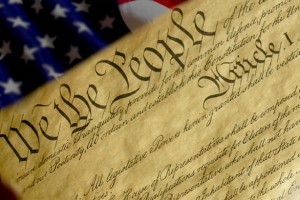
Somehow that ordinary and simple concept seems to have escaped the minds of those who construe the meaning of the Constitution. The Constitution is nothing but a contract, an Agreement between the original 13 colonies to work together to “form a more perfect Union.”
In my humble opinion the Justices of the Supreme Court seem to think this basic principle doesn’t apply to the contract called the Constitution. They are able to find things in the document that were never there, or never intended. Words and issues that are not within the 4 corners of the document. Things that just fit their perception of how society should work are made a part and portion of our governing document. It is grasping for power.
Justice Antonin Scalia once observed in an important dissenting opinion that he wasn’t sure the Supreme Court even had the authority to look at the question before the court. Can that Court decide things anyway they want to without authority in the document itself? Apparently they think so!
Here are a few interesting comments about our Founding Document, The Constitution of the United States of America.
“Our Constitution was made only for a moral and religious people.”
–John Adams
“The Constitution is not an instrument for the government to restrain the people, it is an instrument for the people to restrain the government—lest it come to dominate our lives and interests.” –Patrick Henry
“An act of the Congress of the United States . . . that assumes powers . . . not delegated by the Constitution, is not law, but is altogether void and of no force.” –Thomas Jefferson
“The sacred rights of mankind are not to be rummaged for among old parchments, or musty records. They are written, as with a sun beam in the whole volume of human nature, by the hand of divinity itself; and can never be erased or obscured by mortal power.” –Alexander Hamilton
“Miracles do not occur at random, nor was it the author of this book (The Miracle at Philadelphia) who said there was a miracle at Philadelphia in the year 1787. George Washington said it; and James Madison. They used the word in writing to their friends.” –Catherine Drinker Bowen
Were religion and morality important in preserving the Constitution?
Here’s what the Father of the Constitution said: “. . . every rational effort (should be made) to encourage schools, colleges, universities, academies, and every institution for propagating knowledge, (to teach) virtues and religion among all people. (It is) the only means of preserving our Constitution.” –James Madison
“Of all the dispositions and habits that lead to political prosperity, religion and morality are indispensible supports. . . . Whatever may be conceded to the influence of refined education . . . reason and experience both forbid us to expect that national morality can prevail in exclusion of religious principle. –George Washington
-

By: Steven W. Allen, J.D.
Steven W. Allen, J.D. is an author, speaker, and retired attorney. His book “Founding Fathers – Uncommon Heroes” is popular with all ages and is used in many schools. See his other books at www.StevenAllenBooks.com
-


-
The Federalist Papers
Constitutional Amendments
Founding Fathers and American Heroes
Founding Fathers and War
What About Benedict Arnold?
Books and Founding Fathers